
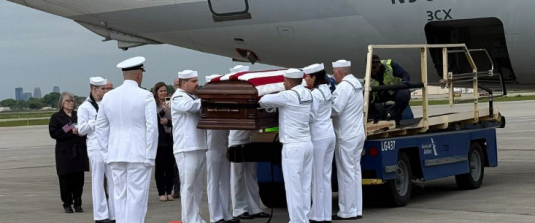
COMING HOME - On May 22, a flag-draped casket holding navy pilot Thomas Ruth’s remains was loaded into a plane in Hawaii and flown to the Twin Cities.
The final return of a lost navy pilot
Thu, 05/28/2026 - 12:00am
“The creator worked this out just right,” commented one veteran. “To have this happening over the Memorial Day weekend.”
“This” is the return of navy pilot Thomas Ruth to his home town 85 years after he left. Ruth’s plane had crashed in an obscure jungle in enemy territory during a battle in the Solomon Islands in 1943; believing the plane to have gone down in deep water, the navy had pronounced his body “unrecoverable.” In 2013, an MIA/POW investigation team learned of a crashed plane in the jungle in the vicinity of the battle site and found human remains inside. Based on various clues, the military contacted the Ruth family and requested DNA samples from three nephews. After the DNA comparison provided positive identification last year, arrangements began for the lieutenant’s trip back to Jackson, where he will be buried near his parents. The Fairmont Sentinel newspaper reports that, after being told her son’s body would likely never be returned to her, his mother had long ago had a stone placed for him in Jackson’s Riverside Cemetery.
On May 22, a flag-draped casket holding Ruth’s remains was loaded into a plane in Hawaii: The forensic laboratory which had identified him is located at Pearl Harbor. At the Twin Cities airport, arrangements had been made for a hearse, a law enforcement escort, and a team of volunteer “Patriot Riders,” veterans who volunteer to accompany military processions on their motorcycles, to take custody of the casket and travel with it on the 2.5 hour drive to Jackson.
The procession planned only one stop, to purchase fuel at the Casey’s convenience store near Ellendale. There, area veterans had been asked to gather for an “honor guard,” a recognition they provide often during ceremonies of various types, including funerals. Veterans were asked to be there in advance of the time the procession was expected, about 4 p.m.
Veterans from the Ellendale and Geneva American Legion and V.F.W. organizations began gathering around 3:30. As they were preparing for the expected arrival, they learned the plane had only just landed in the Twin Cities.
The day was chilly, with temperatures in the 60s which, thanks to the wind, felt like the 40s. The wind made conversation difficult, so the veterans there stood in tight groups or retreated to their cars to wait. No one left. No one complained. They chatted amicably about a wide range of subjects.
Having been asked to be there for the sake of some newspaper coverage, I was now also compelled to wait. I’m grateful I did.
The conversations among the veterans as they waited provided me with an insight. However far apart their birth years may have been, veterans came of age in the same place. They were faced with physical, mental and emotional challenges–their drill sergeants made sure of it–and leaned on each other to overcome them. They learned who could be relied upon and who could not, and were forced to recognize that very little in life is “fair.”
That hour-long wait allowed me a glimpse at why veterans feel so strongly connected to one another. Wherever and however each of them grew up, the compacted, concentrated coming of age they have in common has made them brothers.
So given that it has now been 109 years since his birth, it could be said there are no members of Thomas Ruth’s generation waiting to welcome him back to his hometown. On the other hand, he has hundreds of brothers whose hearts are lifted to know that he has finally come home.