
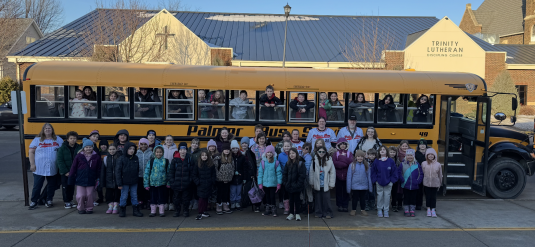
A group of well wishers joined JWP school bus drivers (adults, from left) Jennifer Ziemke, Judy Lichtsinn, Nicole Bowman and Barry Olson in honor of bus driver appreciation day. A note from Nicole: "A big thank you to Marissa DeFrances for washing the buses!"
Bus Driver Appreciation Day Feb. 18
Thu, 02/19/2026 - 3:00am
February 18 is Minnesota “Bus Driver Appreciation Day.”
For the father and daughter pair of Barry Olson and Nicole Bowman, becoming a school bus driver was not a career they would have chosen. Now, though, it’s one they wouldn’t want to give up.
The two are employed by Palmer Bus Service and drive routes for the Janesville-Waldorf-Pemberton school district. Nicole has gone so far as to become the service’s site manager for JWP.
Barry began about 10 years ago when former site manager Tim Engel learned of his retirement from an Owatonna job of 41 years and suggested he might use his open time to drive a van route, which does not require a commercial drivers’ license (CDL).
Though he had to be asked twice, Barry gave the job a try and was soon taking the six-week training needed to earn a CDL and drive the bigger vehicles.
These days he’s among the minority of JWP drivers who don't mind driving in the Twin Cities metro area. “Sometimes construction or some other factor can throw a wrench in things,” he admits. “But you always find your way out of it sooner or later.”
Closer to home, however, the two say only a mail delivery worker knows the roads and residences of the area better than a typical bus driver.
Nicole decided to give the job a try in 2020. She stepped right into the big buses, taking the permit test, doing the practice driving, and then testing on the road. She notes her road test was in the flat-faced bus, a vehicle which has certain eccentricities because the driver is actually sitting a few feet in front of the front axle.
Each school day, JWP drivers pick up nearly 350 children–about half the district’s students– across a wide area which Nicole describes as spanning from Waterville to Minnesota Lake. As site manager, Nicole arrives at 5:30. Other drivers are not far behind; they give their respective vehicles a pre-trip safety check and then head out on one of seven routes. From the time they arrive to the time they return their again-empty buses to the garage is about two hours.
However Barry and Nicole seem to feel the job of bus driver is not one to be measured in hours, but rather in connections and accomplishments.
“We’re like an aunt or an uncle,” says Nicole in an attempt to describe it. “The kids know us, they trust us, they rely on us. They know we’ll be there and we’ll get them where they need to go.
“We’re the first and the last non-family person our kids see each day, and in some cases we spend more than an hour together.”
With a decade of driving behind him, Barry observes, “It’s a lot of fun watching the kids grow up.” He mentions the difference between a shy or nervous kindergartener and the same child a few years later. “And then there are the younger brothers and sisters,” he mentions. “Over time, we get to be there to see a whole family of kids as they move across the grades.”
Nicole mentions that, as site manager, it is her job to arrange the bus routes. As families arrive in the district and as children reach school age, decisions have to be made regarding which route will be adjusted to pick up new passengers. The decision takes much more into account than most people might realize.
“Of course there’s the location of the home and what routes go nearby,” Nicole begins. “But then there’s the age of the child.” An important factor is the direction the bus will be facing as it arrives–whether the child will have to cross the street or will be able to step directly into the bus.
“Especially if it’s a busy street,” she explains, “we don’t want a small child having to walk across it.”
The nature of a bus driver’s duties automatically make it a part-time job, with many typical route drivers working four hours each day. Many get additional driving hours by taking on field trips or transporting groups to various competitions and events. Once at the destination, bus drivers often get free admission.
Barry describes a set of tours designed by a JWP history teacher who has taken students to various locations in the region which relate to the subjects they are studying. Since he was present for much of the dialogue, Barry says the tours–which have included the First Nation History Center at Morton, the “Little House on the Prairie” area around Walnut Grove, and sites significant to the Jesse James manhunt around Northfield–have been enjoyable and informative.
“You just never know what this job will bring you,” he says of each day.
It also helps build certain habits, the two drivers relate.
“It’s gotten so I evaluate a vehicle automatically,” says Barry of the pre-trip safety checks. “Pretty much any car I walk by, I’m sort of subconsciously checking to see if the tires are properly inflated or if there’s anything hanging under the carriage.” He laughs as he tells he must sometimes remind himself NOT to stop at railroad tracks and open the doors when he’s driving his own vehicle.
Nicole acknowledges that the part-time nature of the job and the 40-foot length of a school bus are probably big factors in an ongoing shortage of bus drivers. She tells of individuals who have begun the training process by studying the procedures and rules, but gotten behind the wheel of a bus for their first practices and stated, “It’s just too big.” Others, though, have declared happily, “This is easy!”
Both she and Barry acknowledge there are elements of driving buses which can be intimidating.
“It maybe takes a certain mindset,” Nicole says. “You have to be flexible. You have to be ready for a challenge or two.
“But it’s also a lot of fun, and most of the ‘surprises’ are good ones.”
She describes being out in public, hearing her name called, and having some of her daily passengers run up to her and give her a hug. Barry tells of families and children who make certain he is acknowledged for holidays like Christmas and Valentines’ Day.
“Being a bus driver is being a part of each kid’s education,” observes Barry. “It also means you’re part of their life. They may not always pay that much attention to you, but they know you’re there.”