
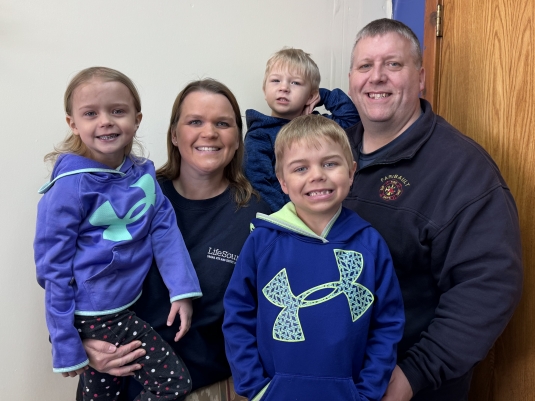
THRIVING - The family of Kayla and Josh Bauer has been profoundly impacted by organ donation. Coyle, 7, (at front) received a kidney transplant before he was 2 years old. With him are his younger sister Paisley and his brother Barrett.
Donate life month
Local family has deep connection with organ transplants
Local family has deep connection with organ transplants
Thu, 04/16/2026 - 2:15am
Josh and Kayla Bauer want the world to know their 7-year-old son Coyle is thriving because he received a kidney through the organ donation program.
Coyle is a member of the Waseca Cub Scouts, a first-grader in the Waterville school district, and older brother to his siblings Paisley and Barrett. He enjoys spending time outdoors, including riding 4-wheeler. A baseball fan, he tossed out the first ball at a “Donate Life” Twins’ game last summer, and has seen his own image on billboards and the sides of Twin Cities buses, where it was displayed to publicize the “check the box” campaign encouraging people to indicate on their drivers’ licenses that they are willing to be donors.
Prior to his eighth birthday in October, Coyle will be celebrating his sixth “kidneyversary” in June.
Josh and Kayla now serve as ambassadors for LifeSource, the Minnesota-based agency which helps facilitate donations, because they want others to have the same life-changing opportunities provided to Coyle.
They sought to share their story with Pioneer readers because April is national “Donate Life” month, and because their personal experiences have shown them the immeasurable difference a donated organ can make.
Josh, whose 20-year anniversary as a Firefighter Emergency Medicat Technician with the Faribault Fire Department will be this August, explains their experiences began before Coyle was born. A small abnormality occurred while Coyle was developing in the womb, and made itself known during routine prenatal checkups. The baby’s kidneys and bladder were enlarged; a small “flap of skin” blocking his urinary tract was damaging the kidneys by causing them to retain harmful waste fluids.
An emergency C-section took place at 37 weeks so that a surgery could be performed to remove the blockage. Although it was anticipated the removal procedure would be simple, it failed to help. Coyle’s kidneys were irreversibly damaged and in danger of failing.
Kayla describes it as a figurative “punch in the gut” when she and Josh learned their 2-month-old baby would need a kidney transplant if he was to survive. She also mentions that the sudden, profound realization of the importance of being an organ donor inspired both her and Josh to register as donors themselves.
Thus began a high-stakes learning curve for the Bauer family. They were informed Coyle would have to reach a certain weight before he would be eligible for a transplant, a weight typically reached only at age one or later. Further, for a donor’s organs to be small enough for a 1-year-old, the donor would have to be either a child or an adult of unusually small size, possibly reducing Coyle’s odds of receiving a transplant. No adult member of the Bauers’ family could donate a kidney simply because theirs were all too large.
Once he had reached the eligible weight, it was a matter of continuing to do whatever they could to keep their son healthy while waiting for a phone call that would change everything.
“We were told to answer any call that came into our phones,” describes Kayla, “even if it was at 2 in the morning. We were supposed to keep travel bags packed, ready to leave on very short notice.”
At 19 months, Coyle was on the verge of beginning dialysis when the long-awaited call came. A 19-year-old donor in central Minnesota would provide a suitable kidney.
“That’s part of why we’re so grateful,” mentions Kayla, noting that someone else’s family had to experience an unimaginable loss in order for Coyle to get what he needed. She says she has used the carefully constructed protocols LifeSource provides to reach out to the donor’s family since Coyle’s transplant.
The Bauers’ narrative makes it clear the process of finding and receiving a suitable organ is a series of small steps, each one reliant on the step before, with no guarantees that each will come to a conclusion that allows the next to take place. And always with high stakes and high speed, since the timeline for removing the organ from the donor and transplanting it is counted in hours.
In Coyle’s case, the Mayo helicopter was sent to pick up and transport the kidney using needed protocols and equipment. The transplant took place in Rochester.
After it had occurred, Coyle had to be closely monitored for weeks to ensure the kidney was functioning sufficiently. He will spend the rest of his life on immunosuppressant medications so that his body does not reject the organ. Another unknown is how long the transplanted kidney will remain viable; Josh says they have spoken with people who have lost the new organ in only a couple years, and others who have kept it for decades. The typical duration for an organ from a deceased donor, they are told, is about seven years.
“We want people to know how meaningful their decision to be a donor can be,” says Kayla. “You don’t know who you’ll be helping, but you will be making a priceless difference to someone who is going through a very difficult time.”