
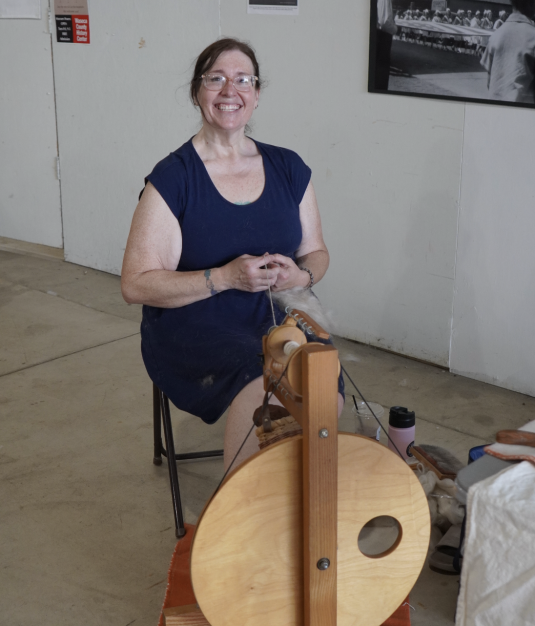
SPINNING FUN - Erica Forsythe was conducting a spinning wheel demonstration at Hodgson Hall during the Waseca County Fair on Saturday, July 11, 2026. Pioneer photo by Ben Revermann
Erica Forsyth covered in hair at the county fair
Thu, 07/16/2026 - 8:30am
The afternoon of Saturday, July 11, Waseca Public Library staff member Erica Forsyth demonstrated the centuries-old art of “spinning,” the process of winding loose fibers together so that they become yarn. Her demonstration took place in the Waseca County Historical Society’s Hodgson Hall.
On a table near her wooden spinning wheel was a variety of natural fibers: sheep’s wool, dog fur, arctic muskox hair (a highly prized fiber known as “qiviut"), Angora goat hair (which is called mohair) and lamb. Said Forsythe, “The dog fur came from an Australian Shepherd who goes by the name of Jimmy. The thing I don’t like about dog fur versus sheep’s wool is the dog’s fur has no elasticity, no bounce back. I can work with the dog fur, it just needs to be mixed in with the wool.”
Forsyth told those in attendance the wheel she was using was bought as a kit, “I bought a spinning wheel kit online for around $400 and assembled it with another librarian. That was just five years ago, now that same kit costs $700.” Her own personal wheel that she keeps at home has the same story, “I bought that one, which was a little more on the expensive side close to ten years ago, now that one costs $800.” She learned how to use a spinning wheel on her own over the years, she didn’t get this skill passed down through the generations, “I saw videos online and read a lot and just did it and got better over time.”
Indicating a baggy filled with sheep’s wool, she said it is her favorite fiber to work with. “Pure sheep’s wool, without the lanolin, is whiter because it’s cleaner. When I work with lanolin filled wool, it’s called, ‘spinning in the grease.’ That’s the easiest way to do it, but it can get messy.” To accentuate how much lanolin adds to the wool, she explained how she recently dropped off five different sheep wool fleeces to be washed; all five still had lanolin in them. “When I dropped it off at the Faribault Wool Mill to be washed it weighed 22 pounds, when I got all of that back and it was lanolin free, it weighed only 10 pounds.” She likes how natural lanolin from sheep skin acts as a water repellant, “Lanolin is good for when I make hats, it keeps some of the water out.” But it doesn’t get as white and it also doesn’t provide a “clean” look and feel to the finished knitted product.
For her demonstration at the fair, Forsyth brought an assortment of of multi-colored fur and hair, “The little kids like to sit down and give the spinning wheel a try. If they do it for long enough, I can give them a little string to make friendship bracelets to pass out or keep.” She had to end the conversation because two children approached and asked about what she was doing, and she happily obliged them.