
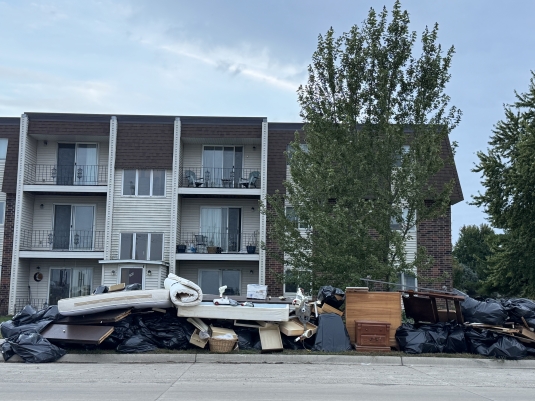
Jeannie Olson and David Melcher escaped from their apartment through hip-deep water carrying what they could grab in only a few moments. Prior flooding had never reached their home in the apartment building at 240 Third Street Northeast in New Richland, but on Saturday morning, a wall of water suddenly washed against their sliding patio doors and began filling their living space. Pioneer photo by Deb Bently
Flood victims describe loss, uncertainty
Thu, 10/01/2026 - 8:30am
Jeannie Olson and David Melcher had lived together in one of four ground-level apartments at Third Street Northeast in New Richland for six years. With a clear view of the town baseball field, they had seen rising water many times, but the closest it had ever come to their apartment building was about 20 feet away.
So around 7 a.m. on Saturday, Sept. 19, they were relaxed and unconcerned as they drank their morning coffee and looked at the standing water outside–until they suddenly realized there was a wall of water moving rapidly in their direction. They could see their apartment would be inundated, so they grabbed a few medical items and a couple rather random armloads of clothing.
Even as they reached and grabbed, the water began filling their space, so that by the time they fled outdoors to their vehicles, the water was up to Jeannie’s hips.
Their two cars were parked outside. Jeannie’s SUV, the taller of the two, already had water above its floorboards, but Dave opened the door anyway.
“I’m glad I did,” he remembers. “Because we saved that car.”
The two got in and drove away, worried whether the engine would die as they pushed through water that seemed two or three feet deep. Behind them, Dave’s car was left standing in water which eventually reached the height of its windows.
They drove to City Hall and spent much of the day there.
“Our shoes were wet, our socks were wet, our pants were wet,” Jeannie describes. Fortunately, local folks were there to help. They were able to go to the Lady Bug thrift shop and acquire some dry things to wear.
That evening, they and a few others whose homes were inaccessible were offered beds at Trinity Lutheran Church. The next day, the food shelf benevolence fund was used to arrange for a few days’ stay at the American Hotel in Waseca for Jeannie, Dave, and a few others who were uncertain where they could go.
When they spoke with the Pioneer on Thursday evening, the two were at a loss as to how they might move forward.
“We’re both on Social Security,” described Dave. “We’ll never be able to come up with the deposit and the first and last month’s rent like they always want for an apartment.
“We don’t have any furniture,” observed Jeannie. “We don’t have much clothes, or blankets or all the things you need for a house.
“I don’t even have hope anymore.”
The two have been back to their apartment since the water receded: the landlord had asked that their ruined possessions be removed so that large-scale cleanup and repairs could begin.
They speak with gratitude of NRHEG high school students who were released from their classes to come help.
“The landlord wouldn’t let them come inside,” Jeannie describes, “but they stood in a line outside and they passed everything along from hand to hand to hand until it was all set out on the curb to be taken away.” Items removed included furniture, wet clothing and towels, dishes, food from the refrigerator–all the everyday things people take for granted.
Some dishes from the cupboard which the water had not reached were salvageable, Jeannie mentioned, but the pots and pans, silverware, and other items at waist height and below were filthy and frightening, and seemed unsafe to keep. The entire apartment stank of dirty water and decay.
“The whole thing is going to have to be completely redone,” Jeannie observed.
Along with their difficult financial situation, Jeannie, 62, and Dave, 71, feel ill-equipped to create new lives for themselves. Dave is a two-time cancer survivor and has a pacemaker.
Besides that, both shake their heads at some of the decisions they made in those last few minutes before fleeing their apartment. “We made some stupid choices,” comments Jeannie, pointing to the pajama pants she is wearing in combination with a sweat shirt.
All the important papers agencies tend to ask for–her birth certificate, her husband’s death certificate, her social security papers–all became mush in the flood.
Dave, a veteran of the Vietnam war, regrets the loss of his “boot camp book” from 55 years ago. He says it was a small booklet with pictures and a list of names of those who attended boot camp together. “There’s no way to ever get that back,” he says, remembering the last time he saw it, it was floating.
Both say they have not been themselves since being washed from their home. Shock was followed by stress and worry, but the sense of shock remains.
“We’re still not thinking right,” comments Dave. “I feel like I’m about 100 years old.”
“I’m biting people’s heads off,” Jeannie says of her temper. “I just don’t have much patience.”
Dave says he feels out of place in his own skin. “I don’t feel quite right, like myself,” he describes.
Both wonder if they will ever feel all right again. “I can’t see any way to fix this,” says Jeannie.
