
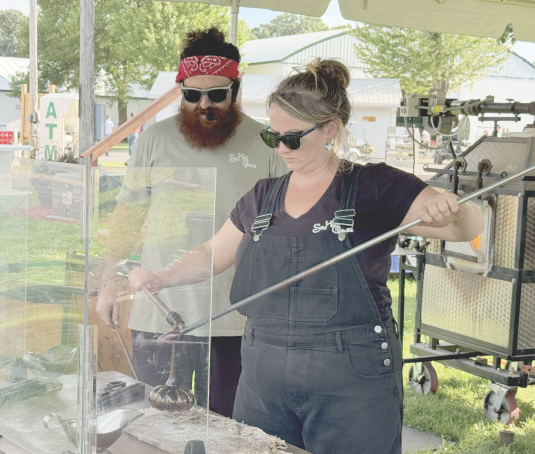
HOT AIR - Glass blowers Kayla Socha and Max Frayman provided on-going demonstrations during the Waseca County Fair.
Glass blowers teach, demonstrate at fair
Thu, 07/23/2026 - 10:15am
As she spins a ping-pong-sized circle of glowing molten glass at the end of a hollow metal rod about four feet long, glass blower Kayla Socha declares, “We like to dive into the history and chemistry of the art.”
Socha and fiancee Max Frayman provided on-going demonstrations and talks during the afternoons of the Waseca County Fair. Their business is SoHot Glass, something of a pun on Socha’s last name, which has a silent “c” and is pronounced “so-ha.”
The two both studied glass blowing in college. They are based in Texas, but are on the road for their business from March to November, giving demonstrations and presentations at fairs and similar gatherings all over the country.
Pieces made during the demonstrations are offered for sale. Smaller, simpler items can sell for as little as $10, while larger, more colorful and more complex pieces can be priced in the hundreds of dollars.
When asked what designs they create, Frayman’s energetic response is, “What do you want us to make?” He and Socha go on to explain they usually choose the projects based on the area where they’re located. Fish are a particular company specialty; Socha says there are two reasons for that. One is that fish are part of the company logo; the other is that “like snowflakes,” fish are fun to make because no two are alike, and they can be creative. Having recently come from a show in California, they mention sea creatures as a popular option. In farm country, they tend to focus on crops, equipment and farm animals.
On their display table as the fair progressed were a cow-themed pitcher, a brightly pink pig, and a very self-satisfied looking white rooster. In honor of being in Minnesota, Frayman had also made a few loons.
Positioned under a canopy tent, their workspace featured two heated appliances, an “annealing” oven and a furnace whose floor was coated with uncolored liquid glass kept at temperatures around 2,100 degrees Fahrenheit. Nearby were two simple-looking work areas which consisted of supports and surfaces where the glass could be suspended, manipulated and joined as various finished items were created.
Observers could not enter the workspace, but had a clear view of each step in the process. Frayman and Socha traded off the tasks of creating various projects and explaining the underlying science.
For one thing, Socha clarified, while silica is the primary ingredient in all forms of sand, it’s not simply a matter of bringing a bucketful home from the beach. The silica used in glassmaking is usually mined from rock formations that were once the bottom of ancient sea beds. The sand is collected, purified, and then ground into a powder. During the melting process, it is mixed with soda ash and limestone.
So-Hot does not make glass from scratch; instead they buy clear glass and melt it.
Glass kept liquid in the furnace, the two explained, is pooled in a crucible at the bottom. It sticks to the end of their blowing tool–a hollow metal rod about four feet long–to be drawn out of the furnace in rounded lumps, then remains liquid enough to expand and shape until it cools below 1,000 degrees.
During the sculpting process, the glass can be rolled in small containers holding various substances to give it color. For example, copper oxide can be used to make the glass red; chromium or iron oxides can make it green.
Air blown through the metal rod expands the glass from the inside; metal hand tools are used to squeeze or stretch the glass. The project is returned to the furnace periodically to keep it sufficiently hot, then brought out for further shaping.
When a sculpture has taken form, it must still go through another step before it can be safe for use or handling. The annealing oven in their workspace is kept at about 946 degrees F. throughout the day. Projects are placed inside it and kept hot so they can all be cooled at a gradual pace overnight.
Without that step, Frayman explains, the glass will someday shatter spontaneously–maybe within a day, maybe a year or two down the road. “It just breaks,” he elaborated. “Since no one knows when it will happen, it’s not safe to have it around people until it’s been annealed.”
The two say they are glad to be–at least temporarily–back in Minnesota, after having spent much of last summer here. “I really enjoy the farm communities,” commented Socha. “People are friendly and open-minded, and they always ask such good questions.”