
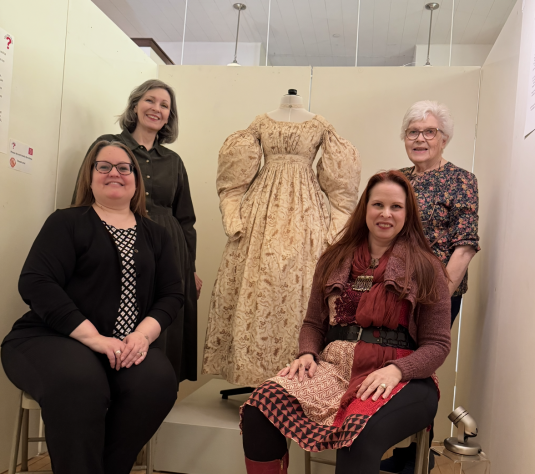
CLASSIC TEXTILE - Waseca County Historical Society staff members pose with one of the four featured items from the current display, "This Old Thing." Pictured here with a 190-year-old wedding dress are (from left) Elizabeth Anselmo, Anna Simmons, Amy Danielson and Pauline Fenelon. Pioneer photo by Deb Bently
Historical Society display leads in diverse directions
Thu, 04/23/2026 - 1:20am
“Think about it.”
Perhaps the overwhelming message of the current display, “This Old Thing,” at the Waseca County Historical Society (WCHS) is that, rather than being entirely in the past, “history” has profound effects on our everyday actions and choices. Along with being a chronicle of what life used to be like, it is also continually connected to who we are, how we think, and what we choose.
Each of four staff members at the WCHS set out to select, from a collection of more than 270,000 items, a single one which had a profound personal impact for her.
While it may seem four items will not engage a visitor for long, that particular outlook does not take the “think about it” factor into account.
“Each of us chose something that, once we had seen it, we couldn’t forget,” observes WCHS executive director Amy Danielson. Posted alongside the four distinctly different items are historical summaries, personal comments, thought-provoking questions and varying amounts of information about the original owners.
Because the WCHS staff would like, as much as possible, to preserve their selections as a surprise for those who visit, this article introduces only one of them, a 190-year-old wedding dress selected by assistant curator Anna Simmons, whose family includes a line of seamstresses who have always enjoyed making their own clothing.
Her coinciding interests in fabric and history led her to select the oldest textile in the collection, an elaborate cotton dress with voluminous sleeves worn by Lavinia Sleeper for her wedding in 1836.
Simmons points out that the dress illustrates changes in customs. Made of cotton, off-white in color with a subtle rusty red pattern printed throughout, no modern viewer would immediately recognize it as a wedding dress. Its broad sleeves and various elegant touches make it clear it is not for everyday wear, but contrary to modern practice, it was expected that the dress would be kept and worn for suitable future occasions.
The dress also speaks loudly regarding Lavinia Sleeper, who was so petite the museum had to use a child-size mannequin to display the dress. Facts and information about the dress, the time in history which influenced its style and appearance, and what is known about the dress prior to its joining the museum’s collection around 1980, are displayed with it. Also posted are questions for reflection–invitations to “think about it.”
Items selected by fellow WCHS staff members include similar opportunities; it would be difficult to think of four items more different from one another, yet the connections they share are strong and clear.
Visitors are also offered a chance to peruse a computer listing, complete with photos when appropriate, of the museum’s many artifacts, to select and post their own “unforgettable” choice, and then, directly or indirectly, to influence possible future WCHS displays.
“We wanted to give people a different perspective on history,” comments data and library manager Elizabeth Anselmo. “It’s not all in the past.” Suggesting that reflecting on historic items can lead thinkers down moral, social, spiritual and deeply personal pathways, WCHS staff members encourage area residents to come experience the surprises, humor, character and sentiment represented by the “This Old Thing” display.