
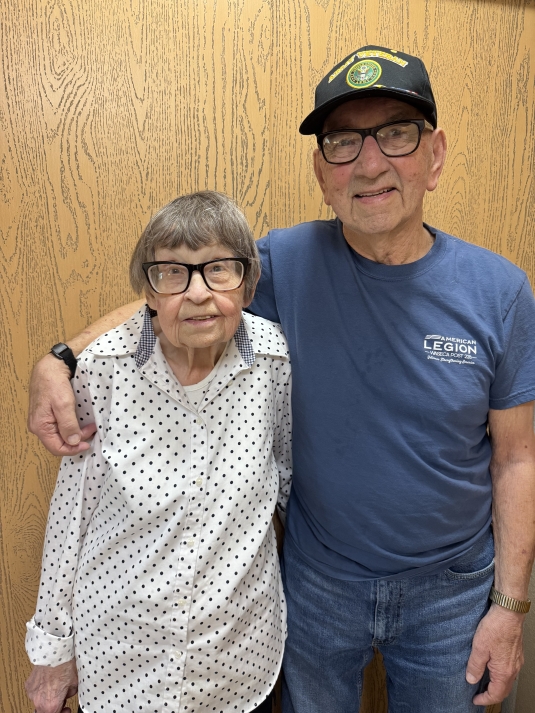
Kenny and Marla Rohl were "young kids" when Kenny was drafted for service in Korea and Japan in 1954. Their first child was born shortly before Kenny left. Another was born while he was in Japan. This December, the two of them will have been married 73 years. Kenny is scheduled to take part in a North Star Freedom Honor Flight in September. At left, Kenny during his military service. Pioneer photo by Deb Bently
Honor flight inspires local veteran to reflect
Thu, 08/27/2026 - 10:00am
“I sobbed when we dropped him off,” remembers Marla Rohl. “I just didn’t know how I was going to make it.”
Kenny Rohl’s draft number came up in 1954: Like it or not, he was headed to Korea to serve in the U.S. Army. His wife was due to deliver a baby in a few weeks.
“When I told them my wife was pregnant, they said I had to prove it,” Kenny said of the draft authorities at the time. “So I brought her to the courthouse,” he remembers with a chuckle. “No easier way to prove it than that.”
Both Kenny and Marla had attended Waterville High School; Kenny graduated in 1951. The two had married in 1953 and in December will have been married 73 years. They raised five children together and now have 15 grandchildren, 28 great-grandchildren, and 1 great-great-grandchild.
But in 1954, “We were two young kids, just doing our best,” remembers Kenny.
Thanks to Marla’s visit to the courthouse, Kenny was offered a delay and was able to stay in Minnesota to welcome their first child, Kenneth, into the world, but then he was off to basic training. During the months Kenny remained at Fort Leonard Wood, Missouri, the couple shared housing in nearby Waynesville. “It wasn’t much of a house, almost a shack,” remembers Marla.
Something else she remembers is that, when she visited base and the baby would be crying, officers would suggest that Kenny should accompany his wife and child home.
“It was one way to get to spend more time with him,” says Marla with a smile.
No techniques could help, however, when it came time for Kenny to be deployed to Korea a few months later. Kenny’s parents, Chris and Jim, transported Marla back to Waterville. Kenny headed overseas.
Open conflict between North and South Korea had begun in 1950; a ceasefire agreement was reached in 1953. Although U.S. forces were still stationed in the country, Kenny remembers recognizing that he was part of a drawdown process.
“They called me an MP [Military Policeman],” he remembers of his job in Korea. “But I was just a guard.”
He and his platoon, he explained, would be stationed two at a time on trains. They weren’t assigned to protect the entire train, but only the boxcars which happened to be carrying goods or equipment belonging to U.S. forces. One guard–the one with the higher rank–would get the more comfortable seat in the engine.
As a private, Kenny was always stationed at the end of the train, usually in a boxcar. Temperature control consisted of deciding whether to have the car doors open or closed. Seating was either on some of the materials being transported or the floor.
“The job was pretty boring, really, with no one to talk to.
“I would sit and watch the grass go by.”
As for guarding military property, he recalls never being called upon to prevent any theft or incursion. A vivid memory for him, though, is the sympathy he felt for the Korean citizens whom he would see working in the rice paddies. Poorly clothed and thin, their appearance showed what a hardship the war had been.
“The trains didn’t move all that fast, and they would stop at stations or even just out on the tracks somewhere,” Kenny recalls. He and his platoon members shared stories of small interactions. One was a comment on the quality of the “ready to eat” meals supplied by the military.
“We had this canned hamburger,” he describes. “Sometimes we would throw some to the people in the fields, and they would throw it right back,” he says with a chuckle.
Other elements of the job were no laughing matter. The trains often included open-topped cars piled high with coal. “When people would steal the coal,” he remembers of some of the cargo on the train, “I would just sit there and watch.”
In fact, he sympathized. “They didn’t have anything else to keep warm, or maybe to cook their food,” he remembers thinking as people would take risks climbing up on top of the mounds of coal and tossing it down for others to collect. “I was glad it wasn’t my job to stop them.”
While in Korea, Kenny received the news a second child was on the way. Marla still has a shoebox-sized tote filled with the letters she sent Kenny during his time in the service, all mailed with 3-cent stamps.
Kenny admits he wrote only occasionally. “It would have been telling about the same things over and over,” he justifies. “And what was there to say?”
In his free time, Kenny sometimes visited and helped at Korean orphanages. “There were a lot of them,” he remembers–meaning both the facilities and the orphans they housed. Despite the language barrier, Kenny says he played with and tried to entertain the children for a few hours during his visits, which he enjoyed. “I figured if I couldn’t be with my own children, at least I could help some other ones,” he recalls.
By the time he received “just a square little postcard” notifying him he had a second son, Kenny’s platoon had moved to Japan, where he fulfilled the second year of his deployment.
His new assignment was very different from the nearly sleepy feel of his time in Korea.
In terms of his everyday duties in Japan, Kenny comments, “I got lucky.” Not long after his arrival, he was approached by “a young kid” who asked only “Do you know how to type?”
When Kenny’s answer was yes, he was informed, “You’ve got the job!”
Turns out, the “kid” was finishing his tour of duty and had apparently been told to find his own replacement, the only named qualification for which was the ability to properly place one’s fingers on the home row of a typewriter and then hit the correct keys. Kenny says he was an adequate typist, but was not asked to prove that in any way before being taken on as a clerk.
The job made it possible for him to be among the first in line at the mess hall, and it meant he spent his working time indoors, in an office, rather than out in the field performing physical tasks–except during training exercises.
“These guys, they were about as gung-ho as you could get,” he observes. “They went on a lot of drills.” A particularly vivid recollection for him was being part of a training exercise during which the navy, air force and army cooperated in an amphibious takeover of a small island.
He remembers being somewhat awed by the size and number of the machines and people involved. However, his most vivid memory is feeling as if he might drown as water washed over the sides and began filling his open-topped amphibious troop transport vehicle. “It was a lot of water,” he says, shaking his head.
Then one blessed day his tour of duty ended and it was time to go home. Kenny can’t help laughing as he remembers packing a duffel bag full of his uniforms, then being told by someone in charge of the flight, “You can’t take all that.”
“So I dumped it out,” he says lightheartedly. “I never wanted all that stuff anyway.”
He returned home using a series of different transports, none of which were particularly efficient. In one case, a train car he and some fellow veterans were riding in was simply left parked in a train yard overnight. But eventually, his father picked him up from a bus station in the Twin Cities and brought him home to Waterville. Kenny remembers walking toward Marla and his two sons, one of whom he was seeing for the first time and the other of whom was a much different boy from the baby he had said goodbye to. Though he knew who they were, he also felt as if he didn’t know them.
The feeling was mutual. Marla had been showing the babies pictures of their father and telling them he would return, but still he was something of a stranger to them as he arrived.
Kenny acknowledges that, however tough it had been for him in the army, it had been at least as challenging at home for Marla, who was taking care of two young children on her own. “Sometimes, you’re surprised at what you can do,” says Marla, remembering that time. Both acknowledge it was made bearable mostly because of assistance and support from Kenny’s parents, whose house was next door.
The two went on to raise their family in Waterville, gradually adding on to the small house Marla had lived in while Kenny was away. Marla was a stay at home mom. Kenny worked at a few jobs before getting one at Brown Printing that lasted for decades until his retirement. Except for an occasional family trip, neither did much traveling.
Now, at 93, Kenny is scheduled to take part in a Sept. 16 “Freedom Honor Flight,” a whirlwind tour of the memorials and monuments in Washington, D.C. offered to qualifying veterans at no cost.
Honor flights are a nationwide non-profit initiative to give aging and terminally ill veterans the opportunity to visit the memorials erected in our nation’s capital to commemorate the conflicts they served in and the sacrifices they made. Kenny’s trip is through the North Star Hub of the organization, which serves 15 southern Minnesota counties. Priority for the trips is given to veterans who served during World War II or the conflicts in Korea and Vietnam; most are in their 80s or 90s.
The one-day trip includes an early morning departure from the Rochester International Airport and coach bus transportation taking them to many memorials and to Arlington National Cemetery. Elements of honor and acknowledgement take place throughout the day, sometimes including a special greeting at the D.C. airport or even a police escort to ensure the buses can meet their tight schedule in busy traffic.
Each veteran on the flights is accompanied by a “guardian,” a family member or assigned volunteer who provides support and generally looks out for his or her welfare. There is no cost to the veteran; guardians pay for their flights.
Kenny says he is looking forward to the trip, and expresses gratitude his daughter, Sherry Volkmann, is able to join him.
Never having been to Washington, D.C., Kenny expects it will be quite a learning experience for him. Having once set foot on Iwo Jima island, the site of an intense battle near the close of World War II, he looks forward to seeing that particular memorial, but expects to appreciate them all.
As for being honored for his service, he says yes, 1954 and ‘55 imposed hardships on him, more in the form of being away from his wife and children than in terms of risks to his safety or health. The difficulties he faced abroad and those Marla overcame back home helped them feel grateful for the everyday, midwestern lifestyle they went on to develop together. He looks forward to the stories he will have to share when he returns.
“It should be quite a trip,” he predicts.