
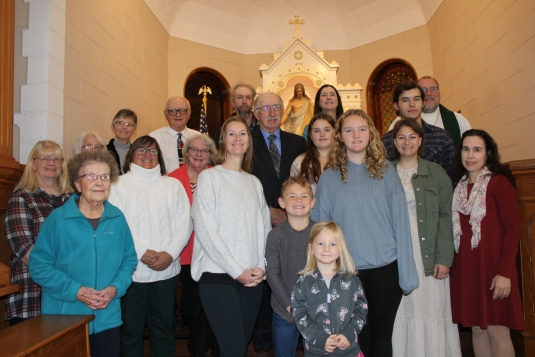
CHURCH FAMILY - Members of Immanuel Lutheran Church of Freedom Township on a recent Sunday morning. Below: The church organ was built in 1885. Its rich tones fill the church every Sunday.
Janesville area church celebrating 150 years
Thu, 12/14/2023 - 11:39pm
Immanuel Lutheran Church of Freedom Township is celebrating its 150th anniversary with four events spread out from Oct. 22 of this year to October 20 of 2024. Every three months between now and then, a special service will memorialize various phases of the church’s history.
On October 22, special guest pastor Jared Korb, son of pastor Glenn Korb who served the church from January 1991 to August 2013, will be coming from his home congregation at St. Luke’s Lutheran Church of Worland, Wyoming to deliver the day’s message. On display in the church will be pictures and memorabilia from Immanuel’s founding in 1874 through the end of the tenure of Rev. Richard Cloeter, who served the congregation through 1962.
All who would like to attend are invited. The service will begin at 9 a.m.; Immanuel Lutheran is located about 8 miles south of Janesville along County Hwy 3.
According to histories kept over time, the church’s roots rest on services which began being held in Janesville area homes in the mid-1860s, not even a decade after Waseca County’s 433 square miles were given their name and boundaries. The gradually increasing number of pioneer members were able to build themselves a simple church home which they dedicated on Oct. 22, 1874. When it adopted its constitution in 1880, 29 people (men only) signed. The congregation has been affiliated with the Missouri Synod since 1892.
While there were public school districts in the late 1800s, Immanuel’s first full-time pastor began teaching in the church building in 1884; the congregation built its own schoolhouse the next year. Church histories record that pastors continued to be teachers until about 1905, when a teacher was hired. Immanuel continued to operate its own parochial school until 1945; at that time the building was moved to Alma City.
Also in 1892, the simple one-room church building had a chancel (the area where the altar stands) added at the front and bell tower constructed at the entry, giving it the outline it still shows today. During the congregation’s seventy-fifth year, 1949, the structure was raised, rejuvenated, and had a basement and parish hall added underneath.
The church’s pipe organ was acquired from Trinity Lutheran Church of Faribaulti in the winter of 1918. Built by the Barckhoff Organ company in Ohio in 1885, it cost $650 when purchased new; Immanuel was able to purchase it for $275 from Trinity Lutheran Church of Faribault. It is interesting to note that pastor salaries at the church in the 1880s ranged from $350 to $500 a year.
Church member Phil Marquardt, 76, the generations of whose family have attended the church since the 1800s, shares a piece of family lore. Marquardt’s grandfather was among those who helped move the organ and occasionally repeated the story of transporting the impressive instrument, about 8 feet wide, 6 feet deep and 12 feet tall, over snow on a horse-drawn sled. “He always said it was ‘colder than a well-digger’s gizzard,’ ” remembers Phil. “And there they were, all struggling to get this giant thing safely across the countryside.”
Almost a personality to itself and older than most parts of the church building, the vintage organ was restored in 1992 at a cost of $12,000. Its rich sounds continue to resonate at every service. Although church members have been told the instrument would sell for $60,000 or more, its resale value is of no importance. “We’re not quite done with it yet,” says Phil.
Agreeing with him are his brother Len Marquardt, 71, and the congregation’s oldest member, Eldora Krause, 94. All three agree that the organ, the congregation’s reputation for singing, and the rich history of the church band are central to the attachment they feel to Immanuel.
The three have all been members at Immanuel for about the same length of time: Phil and Len since birth and Eldora since marrying area farmer Harold Krause in 1948. Each has been very active. Among them they have taught decades worth of Sunday School, cleared miles worth of sidewalk, thrown enough “dartball” darts to sink a ship and, perhaps, played years’ worth of music.
Eldora comments, “I really enjoy coming to church. I hear the word of God, everybody is friendly. It’s a place of worship with the liturgy and the singing.”
Eldora’s arrival was just prior to the closing of the church school and the construction of the church basement. She remembers a time when women all wore hats to church–and when the women and children sat on the south side of the building and the men on the north.
Though Phil and Len were children through those years, they recall family members explaining the custom. The church had a wood heater located at the southeast corner of the ground floor in those days. Between the location of the heat and the chilling effects of a north wind, that meant the temperature on the south side was more comfortable.
“They were being considerate,” observes Phil. “It wasn’t any sort of prejudice or anything.”
Like Eldora, Len says he feels very comfortable in the church. The friendly atmosphere, the music, and his long history make him feel “almost more comfortable here than at home.”
He relates an uncle’s story from the time of wood heat, saying that it was his job to come well before service times and start the fire. Given the dusty nature of burning wood, it was also his task to dust the church pews as the building grew warmer.
“Once, I guess, he was running a little short on time,” recalls Len. “So he only dusted the seats, not the backrests. Well, when service was over he saw from his seat near the back that everyone standing up had lines of dust below their shoulders.
“That was the last time he let himself run late–or at least so he claimed.”
The three interviewees seem to agree there are certain things central to who Immanuel’s members are as a congregation.
One is the annual “Mission festival.” Taking place outdoors in a church members’ grove during the summer, the festival is one of few remaining from a decades-long, region-wide tradition. Phil, Len, and some of their family members play trumpet in the intergenerational band which accompanies the outdoor event. They have, probably, dozens of family members from prior generations who traveled many miles to be part of festivals sponsored by other churches.
Mentioning yet another uncle, Len describes being on a drive with him far from home when the uncle pointed at a stand of trees and declared, “I played in a mission festival there.” Still kept at Phil’s home are a variety of music books from those times. “It was complicated, demanding music,” he comments.
“We’re long on tradition,” admits Phil as he mentions the congregation’s Christian education program. He, Len and Eldora all comment on how the Sunday School Christmas pageant, always held on Christmas Eve, is near and dear to the members’ hearts. After all, Phil and Len were once participants, as were Eldora’s children. The subsequent generations have followed. The church is festively decorated, complete with a tree which reaches nearly to the 15-foot-high ceiling. Both the children and the congregation take their turns singing.
Also an important tradition is the annual Vacation Bible School session, held in the summer and followed by a children’s program. “It’s very satisfying and enjoyable,” Len continues. “We’re extremely proud of our VBS. “The way it connects our kids to the word of God is life changing.”
“These are all things that are really, really special to us,” says Phil. “We’re grateful and proud that we have been able to keep them going.”