
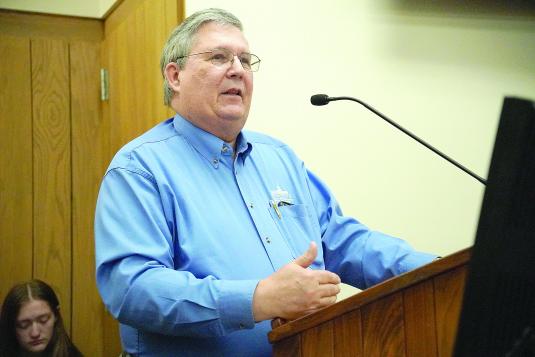
UPDATE - District 24A state representative John Petersburg speaking to the Waseca City Council during its regular meeting Oct. 4, 2022. Pioneer photo by Eli Lutgens
Legislative update
State representative John Petersburg speaks to Waseca City Council
State representative John Petersburg speaks to Waseca City Council
Sat, 12/31/2022 - 12:55am
Waseca resident and state representative John Petersburg addressed the Waseca City Council during its regular meeting October 4, 2022.
Petersburg has represented District 24A, which includes Owatonna and Waseca, in the MInnesota House of Representatives since 2013. Under newly drawn district boundaries, Petersburg is running for election in district 19B and will still be representing the two cities.
Prior to running for state representative, Petersburg served on the Claremont/Triton School Board, as well as in various other positions including: board member MN School Board Association, Steele Waseca Cooperative Electric advisory board, council member of Trinity Lutheran Church, and treasurer of the Southeast Minnesota Synod of the ELCA. He currently is the minority lead of the Republican Transportation Finance and Policy Committee, as well as serving on the Ways and Means Committee and the Preventing Homelessness Division.
In his address to the council he provided a legislative update, spoke about the handling of the state’s billions-of-dollars surplus and shared his three largest goals/concerns:
Unemployment Insurance
Health Insurance
Bonding Bill
Unemployment insurance dollars are generated through employers in Minnesota. Before the pandemic, the state had $1 billion in reserves. After Covid, the state was $1.5 billion in the red. “We switched from good to awful,” Petersburg explained. “Employers pay that fund, and if we didn’t do anything, we were going to be left paying about $50,000 interest charge to the federal government. Employers would have had to pay that back plus the reserve and we would have seen double digit increases in the unemployment tax to business owners.
“We struck a deal to fund that back to full using some of that surplus and Covid funds.”
Health insurance, specifically MNsure, has seen some waves. Group plans didn’t really change, but premiums rose. Problems began when young people, who were expected to be paying into insurance, were put on free insurance. As a result, a much smaller pool of those insured have had to make up the difference in costs. “I’ve seen people paying anywhere from $1,200 to $1,800 a month with a $10,000 deductible. So you’re pushing over $30,000 a year before it actually kicks in,” Petersburg explained.
To legislate this, a co-insurance program brought down insurance premiums, with one-half billion dollars kicked in from the state to help stabilize the market and make up for the shortfall.
Thirdly, Petersburg talked about subsidy payments, “hero pay,” for frontline workers. Initially proponents sought $1 billion in funding, but the amount was negotiated down to $500 million. The original goal was for each worker to get $1,500 but so many people applied, the ending number was around $487.
“I thought we would get a lot more done,” Petersburg observed. “Waseca desperately needed the bonding bill which didn’t go in. We’re trying to get money for a water tower for ConAgra. They have a beautiful new plant out there and they need water to supply it… I really hope that when we start in January we can do a smaller bonding bill right away to replenish the PFA fund, the public infrastructure fund around water. It can be used as a grant program for water treatment and water towers, as well as other needed infrastructure projects around the state. I’m certainly going to be pressing for it.”
Petersburg said he would like to eliminate the estate tax and cut taxes on the lowest tier of income tax, “benefiting everyone.”
Petersburg reported on other concerns regarding the budget, public safety and violent crime–which he shared is on the rise across the state and especially in the Metro–as well as rate reimbursement increases for health care.
“Those are just some of the highlights and what I expect to happen next year,” Petersburg concluded before opening the floor for questions from the council.
Mayor Roy Srp shared concerns regarding violent crime, and asked what the state plans to do regarding THC laws.
“I didn’t vote for that bill; I thought it was misguided,” Petersburg responded. “It was sold to those who voted for it as a way to have some control over the volume [of THC products]... I don’t think we need to have recreational THC, we already have enough personal escapes… That’s just my personal view. It can have a devastating effect on families.”
Petersburg went on to say that regardless of his personal views, society is changing, as is the approach of many elected officials. “And they make the decisions.
“Some cities are going to have an exemption. For example, Minneapolis and St. Paul have their own minimum wage laws. THC is going to be one of those things.”
Srp shared a brief account of his experience being 40 years sober and expressed frustration over a lack of guidance from the state regarding the issue.
Council member Mark Christiansen asked Petersburg about election reform and said he would like stricter laws regarding how long someone needs to live in an area before running for office there.
Petersburg reminded the council he can’t legally campaign during talks like this but did talk about legislation. Voter ID failed to be passed by direct ballot initiative several years ago and “Is something I think we need to do,” Petersburg said. “I think voting is more than a privilege. It’s one of the most important rights we have. I have concerns that we are watering that down by providing so much time to submit an early vote. I think you miss a lot of debate and discussion up to the point [of election day].”
Petersburg reiterated the importance of absentee voting for military and the elderly, and concluded by saying there has been enough debate in the press and the public regarding the issue.
The entire council thanked Petersburg for his report and encouraged him to return. Petersburg expressed his thanks to the council prior to his departure.