
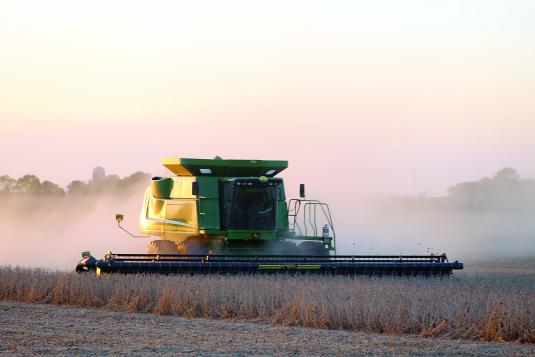
Shown above is a photo from the 2022 harvest of a local field located between Waseca and New Richland.
A look back at the 2022 season
A Day in the Country
A Day in the Country
Sat, 12/31/2022 - 4:02pm
Harvest 2022 is largely in the books and for most, brought about far better than anticipated yields, especially for corn. There were times when area farmers were not quite sure what we had until the combines started rolling. Soybean yields were respectable in most cases, although not generally on a par with 2021. Corn yields, on the other hand, wowed a lot of us, leaving many of us wondering where the yield came from. In an email exchange, Tom Hoverstad, researcher and crop scientist at the Southern Research and Outreach Center (SROC) in Waseca made a couple observations:
First, he mentions a lack of extreme temperatures during the corn grain filling period: “It seems neither the daytime highs nor the nighttime lows strayed far from normal. I would have to check the records, but I think 90 or 91 is as hot as we got July through Sept. I think this was good for corn yields.”
Second, he was impressed by the calm conditions July through September. “Remember how windy it was late winter and spring? What may be more remarkable is how calm it was late in the summer. Our records report wind each day in total miles for the 24-hour period. These daily records are totaled for the month. Both August and September totaled under 3000 miles of wind. I looked at our records going back 10 years and did not find another month with such a low total during the growing season, yet it happened twice this year. I think this may not have been the best for soybean yield and disease development.”
I would concur with Tom’s observations on both counts. I saw only four days with highs in the 90s in the SROC data. Temperatures got warm, but never terribly oppressive for extended periods of time. I ran the squirrel cage fan very little on the lambs this past summer. It was hard to get hay to dry sometimes without any breeze. Didn’t matter if you were trying to make haylage and blow it in a silo. That’ll work anytime. Luckily the lengthy intervals between significant rainfall events were such that none of it got rained on other than a sprinkle. When it did rain, the rainfall amounts were generous.
Our growing season precipitation was a little more hit and miss here than along the Hwy 14 & I-90 corridors. We were fortunate after the dry fall last year to pick up over 4” of rain in April with some of what fell in March coming along for the ride once the ground thawed. Little of either month’s precip drained away. May precip was short, well below what’s normal at the SROC. June was especially dry in New RIchland (2.10”) and even drier at our farmstead where I received less than 2” for the month. There was much snarling and gnashing of teeth when the rains kept passing north or south of us. I started watering the garden in late June and early July. It started raining shortly after that. Want to make it rain? Water your garden!
We got lucky in July and August though, and as Tom pointed out in his comments, with the moderate temperatures and fully developed canopy shading the ground, we made the most of it. We had some cornfield averages over 280 bu./acre with whole farm averages in some cases around 250. The corn had tremendous roots and with the lack of windstorm events, it stood and didn’t snap as in some previous years, which has been a killer about 3 years in a row on some operations. A lot of farmers now carry wind coverage on their corn as standard operating procedure. At least the rootworms had fun in some area corn on corn. No insurance for that. Rotating out of corn is the best cure for it.
Corn matured and dried down much more quickly than expected. At the end of August, most were convinced it could be a long fall. A warmer than normal first half of September and October sped the drying process along so that most were done with corn harvest by the end of October. Many also burned less dryer gas as a result. That was good news in light of all the increased input costs.
Tar spot is a relatively new disease that has shown up in corn. It has been slowly working its way this direction for the past several years after being a problem farther east. The disease set in late, so the yield impact was largely negligible, but it has the potential to be a problem down the road. It could be found in almost every field and type of corn including sweet corn and Indian corn. Luckily, it can be treated with fungicides and there are some major differences in tolerance between hybrids.
Soybeans were a difficult read. As Tom Hoverstad also mentioned, the best way to estimate soybean yields is with the combine. The crop looked really good up until August 19 when we first noticed Sudden Death Syndrome (SDS) in soybeans. A week later, when I got back from the Pro Farmer Crop Tour, it was noticeable in many more fields. In fields affected previously, the areas had grown in size and scope. Many hadn’t used seed treatment to prevent SDS. The expense was cited as their primary reason; since the spring was relatively dry, some didn’t think it was warranted. Given the price of soybeans, I was somewhat surprised that the “throw the kitchen sink at it” mentality hadn’t prevailed. Most claimed they could see the impact of SDS on their yield maps.
For those who used the “kitchen sink” approach, yields were more stable, and some claimed yields were as good or better than last year. White mold was largely a non-issue although scattered plants were affected in some late field assessments. Some did treat fields for white mold where it had previously been a major problem. While in many of those cases entire fields were treated so there was no basis for comparison, where comparisons could be made, it showed a positive economic response.
To sum up, good soybean yields, and fantastic corn yields were the hallmark of the 2022 harvest. Coupled with good prices, cash grain farmers definitely had plenty to smile about despite the high input costs. While soils are drier than we might like going into 2023, the profile was nowhere near full this past spring. Perhaps surprisingly, 2022 proved we could still raise a bumper crop given timely rains and moderate growing season temperatures.