
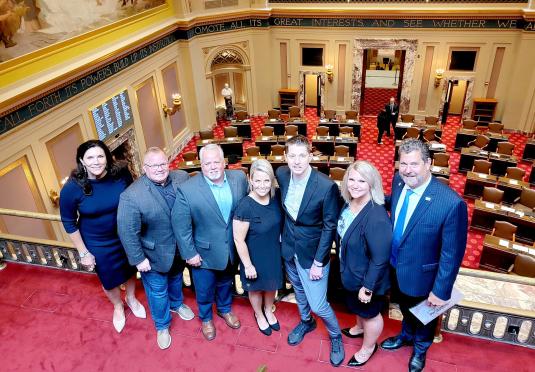
BUILDING STRENGTH - Among the people who helped make the "Matson Strong" law possible were (from left) Senator Julie Rosen, Brian Peters (MPPOA), Jim Mortenson (LELS), Megan and Arik Matson, Waseca County Attorney Rachel Cornelius, and Senator John Jasinski.
Like Matson, new law beats the odds
Matson Strong
Matson Strong
Wed, 12/28/2022 - 10:56pm
“This won’t allow people to come out of prison time after time and commit these crimes.”
— Arik Matson
By DEB BENTLY
News Editor
With the squeezing of a trigger, Waseca police officer Arik Matson’s life was changed forever. As for the person who shot him in January of 2020, the most jail time Waseca County Attorney Rachel Cornelius could foresee was 25 years, despite the fact that he had not only ended Matson's career, but also fired at, without injuring, two other police officers at the scene.
“Sometimes, we don’t recognize there’s a problem, well, until there’s a problem,” comments Cornelius, whose job it was to bring criminal charges against Tyler Janovsky, a Waseca resident and repeat criminal offender who was on “conditional release” (also referred to as “parole”) that January night.
When she began to consider the approach her office would take in charging Janovsky, she discovered a surprising facet of the laws pertaining to the case.
“The penalty was the same,” she says, “whether the perpetrator only attempted to harm the officer, or whether harm was actually done. It also didn’t take into account whether an officer was severely injured and unable to return to work.”
In the case of the January 6, 2020 shooting of Officer Matson, the law only allowed a maximum of 20 years. Due to laws surrounding conditional release (parole), Janovsky would be out after serving only 2/3 of that time.
Megan Matson, Arik’s wife and chief caretaker, recalls being notified of the circumstances. “I was devastated,” she says. “I was expecting life, or 50 years. And then to learn the law allowed 10 years of the sentence to be conditional release…
“Those kinds of policies can be dangerous. After all, Arik wouldn’t have been shot if Janovsky had not been out on parole.”
“And that’s when Megan asked me,” recalls Cornelius, “How do we change the law?”
And thus began a year-long journey. Cornelius reached out to two state-wide organizations, the Minnesota Police and Peace Officers Association (MPPOA) and Law Enforcement Labor Services (LELS), both of which pay close attention to state legislation affecting their members
Jim Mortenson, executive director of LELS, observes, “Police officers are victimized daily. We need some teeth in prosecuting these crimes.”
Brian Peters, executive director of MPPOA, recalls, “Rachel [Cornelius] brought this forward, how do we give offenders in cases like this more [jail] time.”
Peters and Mortenson worked closely with Cornelius and the Matsons to acquire legislative support for strengthened penalties. “It was a year of Zoom calls, meetings, discussions and testifying,” remembers Cornelius. “Turns out, it’s not easy to change a law.”
Legislative bills were drafted in both the House and the Senate and set for consideration during the 2021 legislative session. The Senate bill passed unanimously. The House bill, however, languished.
“It was the same year that George Floyd died,” explains Cornelius. “So there was a political edge to the topic that might not otherwise have been there.”
Since a new law must be agreed upon between the House and the Senate before it can go to the governor to be signed, explains MPPOA director Peters, “The bill was dead.”
The 2021 legislative session ended with a long list of unfinished business, and so a special session was called. “When that happens,” says Peters, “the decision-making process goes to the leadership. They work out among them what will go to the governor and what won’t.”
And in the meantime, the Matsons had happened across a powerful ally.
“We were at the MPPOA [2021] annual meeting,” she remembers. “Arik was receiving the 2020 officer of the year award, and so we were seated next to [Senate majority leader] Paul Gazelka, who was receiving the legislator of the year award. He asked me how things were going, and I told him how disappointed we were that the bill might not pass.
“I was just making conversation, really, not asking for help. But the next thing I knew, he said something like ‘Let me see what I can do.’
“That was a Saturday,” she says. “The following Monday we got a phone call, and on Friday, we were up at the capitol signing the bill.”
The “Matson Strong” bill was passed at the end of June 2021 and has been in effect since last September.
“It was Arik’s wish that there would be no early parole for offenders who harm a peace officer,” says Megan. “We’re very grateful that the bill is in place and can make a difference.
“Naming the bill after Arik is an honor and feels like a thank you for all that was accomplished by the many individuals who made the new law possible.”
Arik also states he is grateful the bill became law. “This won’t allow people to come out of prison time after time and commit these crimes,” he says.
Senator Gazelka, whose intervention effectively “resurrected” the bill, comments “The last three years or so, the police have been underappreciated. The large majority of officers who are doing their jobs well and serving the public faithfully are being lumped together with the small group who are not.”
He says he is disappointed the bill could not be more bipartisan, and therefore had to be negotiated during the special session. “More than 3,000 bills are presented every year,” he observes. “And most of them don’t get done.
“But I said this one had to be in the final agreement, and so I made it a priority.” Doing so required Gazelka to let other bills go by the wayside, but he says he has no regrets: “This is a connecting point for wanting to help the police in the difficult, demanding job that they do.”
During the process of getting the bill approved and signed, Gazelka says he has continued to keep current with the Matsons. “These are good people,” he says. “We’re very grateful that Arik is going to continue getting better.”
The increased penalties under “Matson Strong” cannot be brought to bear against Arik’s shooter, who was sentenced in November of 2020 to the maximum jail time allowed under the law in place when the shooting occurred: 20 years for shooting at Arik and an additional 15 years for shooting at the 2 other officers involved. Janovsky will be eligible for conditional release after 25 years.
The new Matson law went into effect September 15, 2021. Now, someone committing an identical crime would receive a maximum sentence of at least 30 years in prison, and would be required to pay $40,000 in financial penalties. The law also now does not allow for early release on parole. In addition to law enforcement officers, the Matson law protects prosecutors, judges and correctional officers who are assaulted.
According to figures maintained by the Minnesota Bureau of Criminal Apprehension, the number of incidents involving assault against police officers increased by more than 200 across the years 2018 to 2020 (the most recent figures available), with 794 officers assaulted in 2020; of those cases, 56 involved either a gun or knife.
“There need to be severe consequences for those who commit these types of crimes,” says MPPOA’s Peters. “Taking the current climate into account, how can anyone not want to support police officers in the difficult work that they do?”