
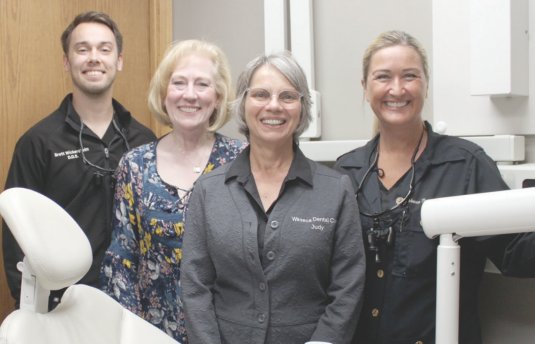
WASECA DENTAL CARE - Dentists Brett Wickershei, left, and Rebecca Thompson, far right with retirees Kathy Miller, middle left, and Judy O’Neil, middle right.
O'Neil, Miller, leave a legacy
Thu, 08/17/2023 - 4:46pm
“Change is often good, but it’s almost never easy." — Judy O’Neil
After 42 years of service and support, Judy O’Neil is retiring from Waseca Dental Care in
Waseca—well, mostly anyway.
Kathy Miller “retired” in 2018 only to return to help out part of every year since then.
The two might be accused of loving what they do so much that they’re not quite willing to let go.
They are also a walking compendium of how dental services in Waseca, and even industry-wide, have been evolving over the past five decades.
Now the office manager for Waseca Dental Care, O’Neil says she oversees “a little bit of everything,” including internet technology, accounting and payroll. She began in 1981 as office manager for dentist Dr. Craig Peterson. At that time, accounting and payroll were records kept on paper ledgers, and the term “internet technology” existed only in science fiction. The office was located in Waseca’s downtown area, in the 100 block of Second Avenue SE.
Dr. Peterson purchased the practice in 1971 and was joined in his practice by Dr. Rodney Kolpin in 1977; O’Neil helped manage the changes in record-keeping, customer scheduling, billing, and more.
The office got its first computer in 1992; the process of modernizing fell to O’Neil.
When Dr. Rebbeca Thompson became the sole owner, “I told her, ‘No more name changes.’ They’re too much trouble!” So rather than using her name for the transitioning business, Thompson chose “Waseca Dental Care.”
O’Neil explains that, each time the practice changed its name, she had to take care of innumerable details, from letterhead and forms to information on file with suppliers; “Even the way we answered the phone,” she recalls.
“I just didn’t want to ever have to do it again,” says O’Neil lightly.
Dental hygienist Kathy Miller has been working for the business for the past 47 years, although she did officially retire in 2018, only to come back periodically.
Miller’s recollection of the 1970s and ‘80s are ones that include so many changes they seem even longer ago.
“We didn’t wear masks or gloves,” she says, shaking her head. “The idea of infection control was washing our hands and using cold disinfection on the instruments.”
What shepherded in the change was the AIDS epidemic of the 1990s.
“Change is often good, but it’s almost never easy,” she comments.
Both O’Neil and Miller also remember the changes brought as technology improved.
One of the first changes that come to mind for Miller is what it used to take to make “films” of patients’ teeth. Images were taken on film which had to be protected from light, then cycled through various chemical baths with pauses in between. She jokes that she got “a lot of exercise” moving back and forth over and over again from the darkroom to her patient and back until the film was finally ready to show the doctor.
“Since 2012, we’ve been able to make digital images. They’re on the computer instantly, and can even be visually enhanced.”
O’Neil describes a change from the earlier years when, each time a patient arrived, she would have to walk back into the treatment rooms to inform the doctor. Later, a system of lit panels was developed.
In terms of bookkeeping, O’Neil and Miller remember that, in the early 1980s, very few patients had dental insurance; for those who did, paper forms had to be completed and forwarded.
Also a change for both of them were the government regulations surrounding privacy and the Occupational Safety and Health Administration (OSHA) requirements, which became more prevalent after the AIDS protocols were introduced.
Here, too, says Miller, “All of that was good, but it wasn’t easy. But we had to have our procedures in place in case of an inspection.”
“After that, though, the small-town feel was gone,” recalls O’Neil, describing times when a parent wanted information about an adult child’s treatment or bills, and she was not allowed to provide it without the proper signed permissions.
“We had to tell them we don’t make the rules, but we do have to follow them,” says O Neil.
As for the Covid pandemic, O’Neil shakes her head.
“We used to have safety meetings where we would talk about all the safety protocols required by the government. We had a plan in case of fire. We had a plan in case of a dangerous storm or a medical emergency.
“Also on the list was ‘pandemic.’ We used to just sort of dismiss it and say, “I guess we would call the department of health and do what we were told to do.”
When the Covid pandemic arrived, Waseca Dental Care was required to close its doors for nine weeks, leaving O’Neil as the only person in the office.
In the end, she reveals, the sanitizing and safety protocols the office was already using proved to be in line with government regulations. As quarantine regulations eased, the office gradually increased its activity back to normal.
A longer lasting difficulty for Waseca Dental Care, and for others in the medical field, was the shortage and costs of supplies such as gloves, masks, and sanitizing equipment created when use of those items expanded so suddenly worldwide.
Even as they weathered nearly constant change, both ladies say something that stayed the same for them was the assurance that the doctors they worked for “have our backs.”
They praise the doctors’ persistent attention to patient safety and welfare, which included making sure that workers in their office could do their jobs well and efficiently.
Both say they have also enjoyed the strong relationships they have been able to build with their patients.
The newest dentist to join the practice is Dr. Brett Wickersheim, who was once a patient served by the two retirees.
“I came here since the time I was a kid,” Wickersheim mentions. “That’s made it really easy to transition into the systems and practices here.
“It’s definitely a certain type of honor to work with these two ladies who have such a history and so much knowledge about the industry and its practices.”
As they ease into their retirements, each of the ladies have plans to spend time with family.
O’Neil and her husband, Mike, of 42 years, plan to go “live life” for a while. That will include spending time with their daughter, son-in-law, and four granddaughters who live in Byron, and with their son who lives in Grand Marais.
“We love to take the role of being ‘hands-on’ grandparents,” says O’Neil.
With her partial retirement since 2018, Miller says she is gradually getting better at relaxing, but admits she enjoys her work so well it has been fun to be back.