
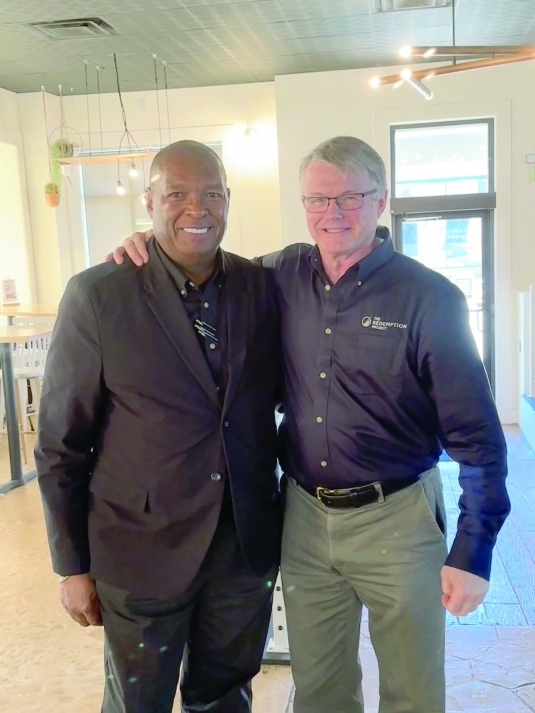
Co-founder of the Redemption project, Dwight Thostenson stands to the right of Steven Fitch, education services director
Redemption Project aims to find felons gainful employment
A real second chance
A real second chance
Fri, 02/16/2024 - 2:29pm
“When we started, we went to various businesses and we asked them, ‘Will you hire some felons?’” says Dwight Tostenson, the chief executive officer and a co-founder of The Redemption Project (TRP), a program which has served inmates from seven prisons located all around Minnesota.
According to a presentation given by Tostenson February 1 during the Waseca Rotary club’s monthly meeting, TRP got its start about six years ago when Tim Owens, a banker and longtime friend of Tostenson, was sent to prison for 14 months. Tostenson said Owens left prison with a new perspective about prison inmates.
“Seventy to eighty percent of them want to do the right thing,” Tostenson summarized. “They leave prison ready to be good citizens…they get a job and start to earn some honest money. Then the results of their background check come back, and they’re fired.” According to research Tostenson cited, the national “recidivism” rate, that is, the number of inmates who end up returning to prison, is about eighty percent within six years of being released.
“In Minnesota it costs an average of $55,000 a year to keep an inmate incarcerated,” Tostenson pointed out. “The United States has more people in prison per capita than Russia and China combined.
“The Redemption Project believes that everyone deserves a second chance–that is, a real second chance when they have the resources and support they need to follow through on their intention to be good citizens. Everyone deserves to build the self-respect and stability that come with having a good job.”
Among the 140 inmates who have taken part in the TRP program, Tostenson informed listeners, the recidivism rate is nine percent.
To date, TRP has seven staff members and 40 volunteers. The program has worked with inmates in institutions in Stillwater, Sandstone, Rush City, Lino Lakes, Duluth, Rochester and, as of this month, the federal women’s prison in Waseca.
Tostenson summarized TRP’s program as having three stages.
The first stage is education. A general invitation is issued to all inmates in an institution, offering them a chance to attend a 14-week education course. “We take everybody,” said Tostenson. “Murderers, jaywalkers, whoever signs up.” One of the few requirements is that applicants be anticipating release anywhere between four and 18 months in the future.
Much like any “class,” the course they attend includes a workbook, homework assignments, oral reports, and the like. The subject matter, however, covers four classic “virtues” and how they apply to life: wisdom, courage, self-control, and justice.
“Our participants often say they’ve never thought about these topics before,” said Tostenson. “To them, for example ‘justice’ is about punishment. We ask them to think more deeply about the positive side of what justice means–that is, to “reward the good”; to show courage and what it means to “endure for the greater good”; or why it’s important to “seek the truthful” as we strive to live our lives with good character and integrity.”
The objective, he goes on to say, is to change the thinking and thereby the behaviors of the students, which got them into prison in the first place. Without a change in thinking, they will return to prison again, when they face the challenges of reintegrating back into “the world.”
Tostenson said he has found it personally rewarding to be the teacher of these sessions. His own perspectives have been broadened and enriched by the many discussions he has led.
The second stage of TRP’s program is to advocate for its participants among the public. Tostenson claimed there are four typical hiring models used by employers when interacting with released inmates–all are unsuccessful except one.
The first hiring model, he said, is simply not to hire felons.
The second is to treat former inmates as “disposable” labor–give them undesirable or difficult jobs and assume they will stay for a relatively short time, thus making room for the next applicant.
The third is “treat them just like anybody else.” However well-intentioned the approach might be, Tostenson described, it is usually unsuccessful because “released inmates aren’t like everybody else.” He named obligations for court hearings, community service, therapist sessions, drug tests and other requirements of their release that, when not supported by the employer, result in the former inmate returning to prison.
The fourth hiring model is where the employer makes minor accommodations so the former inmate can successfully navigate their short-term challenges. Being flexible and understanding of the former inmates’ challenges results in employees who are loyal, hardworking, and willing to go the extra mile when called upon by their employer out of recognition the employer gave them a chance to prove themselves.
TRP staff, he said, has a program of advocacy under which they approach potential employers, explain participants’ sincere desire to reintegrate into society, and work to create circumstances which allow TRP participants to be successful.
“When they have more information and a better understanding,” Tostenson said, “the employers are often willing to work with us.” Companies which have been particularly supportive, he said, include Taylor Corporation, Union Pacific Railroad, the shipping company UPS and distributor US Foods and others.
In addition to the 14-week class, participants in TRP are assigned a mentor and given access to TRP support services personnel. As often as possible, these folks are former inmates themselves who truly understand the challenges and demands that reentry brings.
“Imagine you had fallen asleep back around 1995,” Tostenson offered, “and then you woke up today. How much would the world have changed?”
During his talk, Tostenson shared the story of an inmate who had been incarcerated for 27 years. He had never used the internet, had never seen or used a “smart phone,” had never sent an email. “Now imagine what it was like for this person to apply for a job,” he said.
In addition to helping with job placement, TRP and its mentors provide those who have completed the 14-week education course physical support in the form of cell phones, bus passes, professional clothing, and assistance finding housing. This is due to the fact that most people leaving prison have less than $200 to use to buy clothing, shoes, jackets, food, and sometimes housing and other necessities. TRP spends about $700 per participant in support services to help them get off to a good start.
“Mentors help the participants realize they can get through all these challenges,” said Tostenson. He mentioned one individual who had two job interviews scheduled the next day. But “he was completely overwhelmed,” Tostenson described. “He didn’t believe he could do it and that his life was falling apart. Of course he was anxious. Imagine what it’s like to have your first job interview at age 42.” TRP’s mentor spoke with the participant, assured him that what he was feeling was to be expected, and “45 minutes later, he was off the ledge,” said Tostenson speaking figuratively. The former inmate went to the job interviews and was offered a job the next day.
Funding for The Redemption Project comes from a variety of sources, including private individuals and corporations who believe the program’s three steps program of “education, mentorship and employment” are a way to help reduce recidivism and strengthen society. TRP recently received a $2 million, 2-year grant from the Department of Employment and Economic Development (DEED). While grateful for what the funding will help the program accomplish, Tostenson said “We don’t want to be dependent on government funding.”
Tostenson said TRP is determined to “prove out this model” and to help society–and perhaps especially potential employers–change their perspective regarding released inmates. “People have the ability to change,” said Tostenson. “These folks have done what is required of them as far as the justice system is concerned. We can either turn our backs on them or help them rebuild their lives. The choice is ours.”
Tostenson said that, for him, the moment when he was most proud of what TRP is accomplishing was during a “graduation” ceremony held for a class which had completed the 14 weeks of classroom work. He remembers one of the graduates who was incarcerated for being a drug dealer.
“He said he formerly thought of himself as a good father. His family had a nice home to live in and had all its needs met, thanks to his income from dealing.” Then the inmate acknowledged that he was wrong, saying “While I was providing for my family, I was destroying other families. So, I’m not going be a drug dealer when I’m released.”