
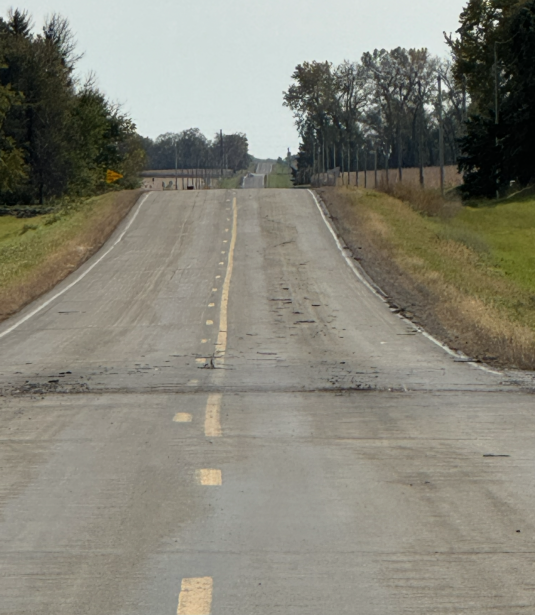
VISUAL TRAP - This roadway in Waseca County provides an example of a “visual trap.” An unfamiliar driver could easily believe this road continues straight ahead, but the hill is concealing a curve. Pioneer photo by Deb Bently
Roadway planning session examines statistics, local experience
County roadway plan improves chances for outside funding
County roadway plan improves chances for outside funding
Thu, 10/22/2026 - 10:00am
Interested and invested parties were invited to a three-hour session which addressed the process of updating Waseca County’s “County Roadway Safety Plan” the afternoon of Oct. 6. Representatives from the Minnesota Department of Transportation and from the Twin Cities company SRF Consulting met with about 20 people who chose to attend representing law enforcement, highway maintenance, and county and township leadership.
Leading the session was SRF consultant Renae Kuehl, a professional traffic operations engineer (PTOE). Kuehl explained that having a highway safety improvement plan broadens the county’s eligibility for outside funding on targeted construction projects. She mentioned her company is in the fourth phase of a four-tiered process helping more than 50 counties update their plans; Waseca County’s was last updated in 2014.
Kuehl shared that the State of Minnesota receives about $37 million in highway safety funding from the federal government each year. About half of that is distributed to local agencies such as counties, municipalities and townships through an application process: local agencies describe a project which they believe will improve traffic safety and apply for funding. Selected projects are granted as much as 90 percent of the cost, with 10 percent coming from local funds.
Kuehl went on to say that the revised plan will not only identify projects, it will include all the information needed to apply to the state for funding them.
The reason for the Oct. 6 session, she said, was to receive input from local groups about actual roadway experiences within the county so it could be taken into account as the plan is updated.
According to Kuehl’s summary, 10 percent of the highway miles in Minnesota are under the control of the state highway system, while 90 percent are locally controlled. Regarding incidents which involve either a death or a life-changing injury, nearly 70 percent occur on locally maintained roadways.
Local safety plans are part of the national “Toward Zero Deaths” initiative which began in 2003. At that time in Minnesota, two decades of data showed a rising trend in severe crashes: 650 or more traffic-related deaths had occurred in three years between 1995 and 2003; the lowest number of deaths during those years was 568.
While acknowledging the only “acceptable” number of injuries or deaths on roadways is zero, Kuehl related that, during the 23 years since the initiative began, deaths on Minnesota highways have been reduced to numbers as low as about 360 in some years, so that roughly 5,000 fewer lives have been lost than trends indicated prior to the program. The stated goal is 225 or fewer deaths per year.
The Toward Zero Deaths (TZD) program has wide-ranging elements from education meant to increase driver awareness, expanded law enforcement to encourage drivers to obey traffic laws, engineering of improved roadways, and strengthened emergency medical services.
When it comes to highway engineering, Kuehl said, TZD takes a proactive approach. Information from all crashes in the state is compiled and underlying factors are identified. Closest attention is paid to “severe” crashes, which in this context are those that entail a death or a life-changing injury.
Data indicated that inappropriately high speeds are contributing factors in more than 20 percent of severe crashes: driver inattention in about 7 percent. Of slightly more than 2,000 severe incidents in 2021 to 2025, about one-fourth involved an “impaired” driver.
Statistics indicate nearly half of all severe accidents occur at intersections; nearly half also involve a “lane departure,” whether that includes leaving the roadway or moving into the oncoming side.
Kuehl presented examples of ways highway construction and signage could help reduce numbers in these two settings. She provided the example of curves where drivers might leave the roadway either because they were unaware of the curve or because they navigated it at too high a speed. For such areas, she offered placing chevrons (> shaped signs) and posting recommended curve speeds as relatively low-cost solutions: she indicated the size and number of chevrons could be selected based on the sharpness–or lack of visibility–on the curve. Another option would be to re-engineer the curve, which would entail construction.
Regarding intersections, she described that accidents are more likely to occur when roads meet at an angle rather than square on.
Where actions at intersections occur because one driver failed to notice a sign, her presentation showed that solutions can range from adding flashing lights or creating a four-way stop to constructing a roundabout which would compel drivers to slow down and pay more attention. Thus, the cost to strengthen safety at the intersection could range from a few hundred dollars for additional signage to hundreds of thousands of dollars for major construction.
Mark Wagner of the Minnesota Department of Transportation’s (MNDOT) traffic engineering department, said that when the department evaluates requests for funding, it weighs the cost of the project as compared to the number of drivers whose safety would be improved, and the degree to which safety would be enhanced.