
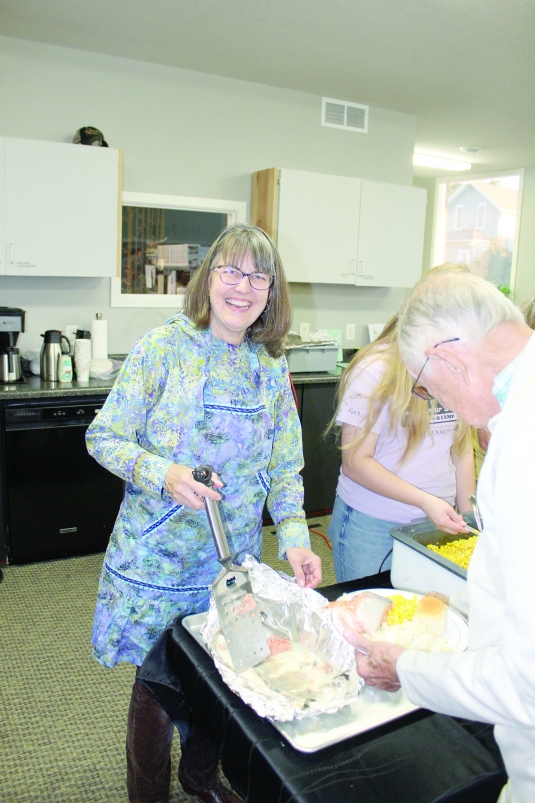
Above: KICY radio station manager Patty Burchell personally served the salmon to diners at last Friday's fundraiser. Pioneer photo by Deb Bently
Salmon dinner Promotes Alaska Christian radio KICY
Wed, 10/16/2024 - 8:45pm
About 60 people gathered at Real Life Covenant Church in the 600 block of Waseca’s West Elm Avenue the evening of Oct. 4 for a free salmon dinner and information about KICY Christian radio station located in Nome, Alaska.
Presenter for the evening was Patty Burchell, station manager, who not only served the salmon personally, but took the stage to spend about 40 minutes sharing the story of her own journey to the organization’s leadership, and information about the population the station serves.
Burchell shared that KICY radio was first incorporated in 1960 and has grown to broadcast on three frequencies–one AM and two FM–across an area in Alaska about the size of the state of Michigan. She referred to the music and Christian programming the station shares as “the background of life” for about 50,000 people who live in Nome, with a population of roughly 10,000, and many scattered coastline villages populated by indigenous peoples and the descendents of gold miners who arrived in Alaska early in the 1900s.
Burchell showed aerial photos of a number of the communities she was describing. Showing Nome, she mentioned that an individual could walk its length, parallel with the beach, in about 20 minutes, and its depth in about 5. She also pointed out that Nome is the only town organized on “a grid,” in other words, with square blocks created by streets, since it is the only community KICY serves which was not originally a native village. The streets, however, are gravel.
“Nothing in Alaska has a solid base,” she says. “The tundra moves, so anything rigid that gets built on it will get broken apart.”
“Residents of the villages live a subsistence lifestyle,” she revealed, showing pictures of open structures where pink salmon filets were hanging to dry. The salmon, she mentioned, is often smoked and then kept for the winter.
Gardening is impractical for a number of reasons, she said, but the many miles of open tundra provide “incredible abundance.” Individuals and families often spend much of the summer camping out in the open spaces where they can gather and preserve many kinds of indigenous berries and roots, including blueberries and chokecherries.
Buildings in Alaska tend to look very “weathered” on the outside because of the harsh environment, she said, but are well kept and cozy on the inside.
In the summer, she told audience members, high temperatures are usually in the sixties, with relatively rare incursions into the seventies and exceptionally rare occurrences of the eighties.
Winter temperatures range within 20 degrees either above or below zero. The Bering sea is usually frozen solid from November to May, as are the streams and rivers which crisscross the tundra.
As far as the people of western Alaska are concerned, Burchell commented, “anything above zero is downright warm.”
She went on, “The snow fills in the uneven spots, and that’s when people can travel between the villages. There are gatherings where people can share music, sing together, and spend social time.” She showed images of a “midnight sun parade” and mentioned that the March Idatarod dog sled race leads to a whole week of celebration, since the mushers arrive in town day or night across about seven days. She said the town embraces the annual event: Schools are closed and people stay up late to greet arriving teams.
Burchell mentioned that she and her fellow volunteers are pleased to serve the scattered population of western Alaska. Much of their programming is Christian music in English, however, the station has a recording studio where local musicians can record translated or original songs for broadcast, since their audience speaks mainly indigenous languages. The station also provides coverage of local basketball games, the Iditarod, fishing reports, and regional and state-wide church conferences, to name a few.
Referring to the station as a “holy flamethrower,” Burchell revealed the AM frequency of KICY reaches as far as 2,000 miles into Russia, especially overnight and when transmissions are purposely aimed eastward.
She introduced the audience to volunteer Luda Kinok, formerly a citizen of Russia who had grown up listening to KICY and decided already as a child she wanted to work there one day. In order to supply listeners in Russia with Christian programming, Burchell said, the station cooperates with pastors located inside the country who create and share recorded material.
Burchell invited those in attendance to support the radio station in a number of ways, including donating funds, praying, volunteering at the station for some of its summer projects, and even joining the staff. “Give us a year and we can teach you radio,” Burchell commented. More information about the station and its services is available at www.kicy.org.