
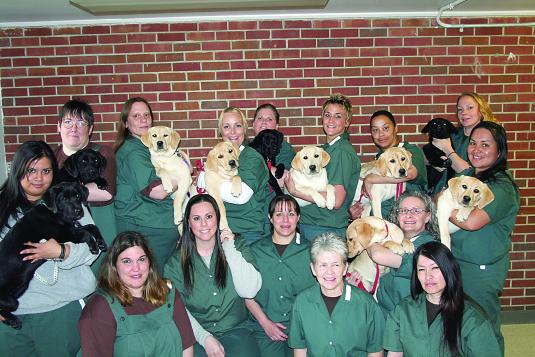
LEARNING TOGETHER: A group of Can Do Canines participants at Waseca's Federal Correctional Institution just prior to the dogs' graduation.
Service dogs in training at FCI
Can Do Canines
Can Do Canines
Fri, 12/30/2022 - 2:22pm
What’s one way to begin a service dog’s training? Send it to prison.
Can Do Canines, the largest provider of assistance dogs in Minnesota, has partnered with the Federal Correctional Institution (FCI) in Waseca since 2011 to provide the first phase of training for twelve of its dogs at a time. Over the past 11 years, inmates at FCI Waseca have trained more than 100 dogs for the non-profit association headquartered in New Hope.
According to Caren Hansen, Communications Manager with the organization, most of the dogs are labrador retrievers or lab mixes about three months old. The animals stay at the institution for six months before moving on to about two years of specialized training elsewhere. Those who complete their programs successfully will be given at no cost to individuals with life-altering conditions such as diabetes, hearing impairment, seizures and autism.
FCI Waseca is one of four Minnesota institutions Can Do Canines partners with, and according to Hansen, is the only “puppy prison” with female inmates. Matt Levisay, a recently retired correctional counselor at FCI Waseca, says he volunteered back in 2010 to begin “Prisoners Assist With Service Dogs” (PAWS) at the site. “Twelve years ago there were not a lot of prison programs to call and ask questions about how to do things,” he recalls. Now the PAWS program at Waseca regularly fields questions from other institutions.
To be selected as a “handler,” an inmate submits a request to join the PAWS program. The numerous applications are screened for discipline history, background animal cruelty issues and knowledge about dogs; a GED or high school diploma is required.
During their training at FCI, all the dogs live in the same space with their inmate handlers. At night, each “bunks” in a cell with two inmates; a baby gate in the doorway prevents wandering (if the dogs were so inclined). Levisay admits that having a dog crate or kennel in the cell makes a small space smaller, but says the handlers do not mind.
He describes the training regimen as a 24-7-365 commitment. The inmates get up in the morning, take their dogs out to a designated walk area, then feed them breakfast. After a short rest, dog and handler usually go out to recreation for a walk and maybe a little training. Then they return to their housing unit where they will interact like any typical dog and owner. Inmates train the dogs on and off throughout the day. They can go back out to recreation during different times for more exercise. During the day and evening, dogs are taken out at predetermined movement times. At nighttime, dogs go out at scheduled intervals–barring an emergency. After a couple of months, dogs are usually housebroken and do not need to go out overnight.
Can Do Canines sends a trainer to the institution to work with puppy/trainer pairs one day a week for two hours of class. During the rest of the week, inmates who have been in the program prior to the current year, known as “seniors,” provide daily assistance. The dogs are trained by inmates in basic obedience and some generalized assistance skills (such as "park" - lying under a chair to be out of the way). Inmates also teach basic mobility skills including retrieving items, opening doors, and hitting handicap buttons.
Levisay speculates that handlers benefit just as much from the interactions as the dogs do–if not more. “Some inmates have never had anything to care for before or someone/something to be responsible for. Inmates learn how to work together within the group, and how to show inmates not in the group what their dog is capable of. They also have to learn patience.
“When the dogs leave it is always a tough day. Inmates have become very close to their dogs and really hate to see them go,” Levisay says. “There are a lot of tears and it is very quiet for a couple of days, but trainers are also happy and proud their dogs are going to the next step of the training process.
“Everyone benefits from this program,” claims Levisay. “The people who get the fully trained dog at no charge at the end get a life-changing friend and partner to make them more independent. The inmates get a marketable skill, that hopefully upon release will lead to a fulfilling job and decrease the chance of them returning to prison. The institution gets a group of puppies that change the whole atmosphere. When the dogs are there it is just a different feel. People love to see the dogs–staff and inmates alike. Their presence makes everyone a little happier. There are not a lot of feel-good things in prison.”
Levisay says he has had several inmates leave Waseca and go on to do great things with animal training. “One inmate got a job at a kennel. After her employer saw her skills as a trainer, she was given the opportunity to start a rescue branch of the kennel. She is now in charge of all the animal rescues for them. She also makes good money offering private training to individuals in their homes.”
The retired counselor says he also benefited from PAWS: “Watching the inmates thrive in this program was awesome. I got the pleasure of attending graduations: Meeting the people the dogs are given to is very gratifying. I walked up and met people expecting to shake hands and instead ended up getting a hug and a huge thank you for what we do. It was well worth all the time and effort.
“Before my retirement, I got the pleasure of assisting numerous institutions (state and federal) in getting their programs started. That was just as gratifying, having our system become known as a standard for dog programs in the Bureau.”