
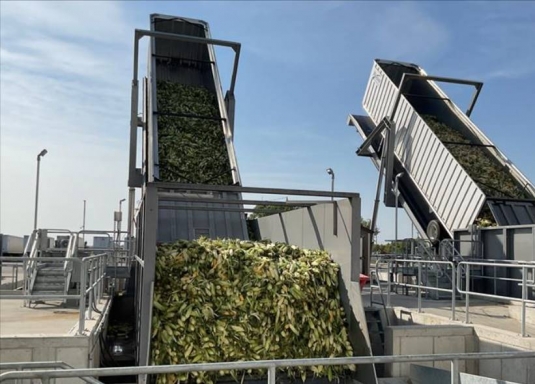
The hydraulic lifts at the western side of Waseca’s Conagra plant are capable of lifting and emptying a 45,000 pound trailer full of freshly picked sweet corn in less than an hour.
Strong harvests despite droughts
Thu, 12/14/2023 - 3:51pm
“Our building is beautiful. Our equipment is state of the art. But it’s the people who make the harvest go smoothly,” says Jeff Kraimer, manager of Conagra’s new 245,000-square-foot facility west of Waseca.
Kraimer mentions that the plant is capable of processing 45 million pounds of peas, 120 million pounds of corn and up to 20 million pounds of rice in their respective seasons. The plant employs roughly 100 people year round and adds another 200 during the harvest season.
Despite this year’s drought, Gary Paulson, director of ag services for the plant, reports that harvests of both peas and corn have been strong. He says yields have been “very good,” with surprisingly little impact from dry areas in fields. In fact, he mentions, field work has been made simpler and smoother because the ground is dry.
The harvest season for Conagra’s sweet corn is timed to begin just as the pea harvest finishes around the last week of July. It continues into the first or second week of October. During that time, trucks are kept on the road delivering roughly a hundred 45,000-pound trailer loads of corn to be unloaded and processed each day.
According to Paulson, the span of time from the moment an ear of corn is picked in the field to when it’s processed, packaged and frozen is between four and six hours.
The speed, according to Kraimer, can be attributed to knowledgeable workers dedicated to ensuring a quality finished product and to modern equipment which performs a wide variety of tasks.
Paulson, who worked at the former Bird’s Eye plant and has 42 years with the Waseca operation, reveals that Conagra contracts with area grower to raise 18,000 acres of sweet corn, nearly all of which are located within 50 miles of the plant.
“About 95% of our growers come back from year to year,” he says. “Some families have been growing crops for us for 40 to 50 years.”
Contracts are spread out across as wide an area as possible, Paulson explains, to reduce the impact of isolated weather conditions, for example, overly heavy rains which might drown out part of a crop. Growers are provided with the seed and given a time frame in which it should be planted. Planting times are staggered so that harvest times will be spread out, allowing a reasonable pace for processing.
As crops mature, scouts travel to assess and report various factors. When it comes time to harvest, Conagra provides all equipment needed to get the cobs of corn off the plants, across the field, and into the over-the-road trucks.
When the trucks arrive at the Waseca plant, the tractor is disconnected and the 45,000-pound trailer is set on a hydraulic lift. One end of the trailer is raised, essentially pouring the picked cobs into the plant for processing. The lifts empty the trailers in 45 to 50 minutes.
Inside, the corn is husked and then run past equipment which automatically grades it for the quality of the kernels and the length and diameter of the cob. Roughly one-third of what’s processed is packaged and frozen as cob corn; the remaining two-thirds is cut off the cob and frozen as kernels.
Kraimer and Paulson both emphasize that the plant’s smooth operations are made possible because of strong connections among Conagra and various facets of the community. Kriamer mentions the farmers who contract with the company, the workers who choose Conagra as their employer, and the truck drivers who transport crops.