
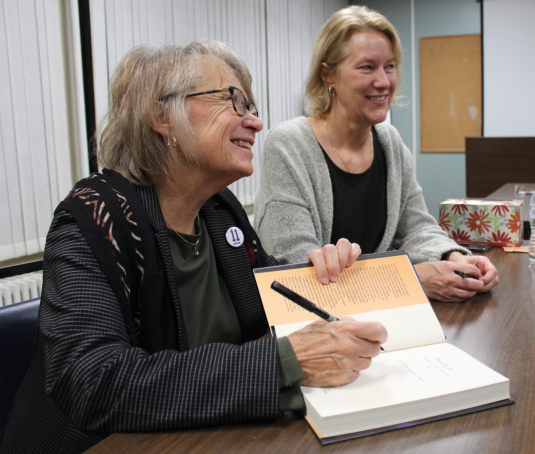
Author Patty Wetterling signs a copy of the book she authored, “Dear Jacob” at the Waseca Public Library. With her is book co-author Joy Baker.
Talk by “Dear Jacob” author Patty Wetterling draws more than 200
Thu, 12/28/2023 - 5:41pm
From 1989 to 2016, it was probably Minnesota’s most famous “unsolved mystery”: Where was Jacob Wetterling? Kidnapped from an otherwise quiet neighborhood in St. Joseph on October 22, 1989, the 11-year-old’s fate was unknown until the research and writing of Minnesota blogger Joy Baker reopened the case and led to the uncovering of new evidence.
Baker’s work was energized when she came to know Jared Schierl, now in his 30s, who had been abducted and sexually abused in January of 1989 in a community not far from St. Joseph, and who was anxious to find closure to the incident which had profoundly affected his youth and coming of age. Schierl, and soon Baker, were convinced the same attacker was involved in both incidents, as well as several more which Baker found in newspaper archives.
In 2016, Daniel Heinrich, who had been investigated in the case in the early 1990s, confessed to kidnapping and killing Jacob, then revealed the location of his body. Heinrich, it turns out, had approached numerous boys across the nearby region in the late 1980s, leading to the unsettling legend of “Chester the Molester” in the Stearns County town of Paynesville.
In September of 2016, 27 years after his abduction, the family of Jacob Wetterling held a funeral for him.
This October, a book co-written by Jacob’s mother, Patty Wetterling and blogger Joy Baker was released. Titled “Dear Jacob: A Mother’s Journey of Hope,” the book is available in hardcover.
Authors Wetterling and Baker came to the Waseca library the evening of November 6 to share their insights and experiences from preparing the book. Attendance at the talk was unexpectedly high: Ultimately more than 80 seats were filled; about another 120 people chose to stand.
Wetterling described having lived more than 20 years in “high gear” after Jacob’s abduction. There were campaigns and appeals to the public for Jacob’s return, all of which metamorphosed into a national leadership role in protecting missing and exploited children. An important accomplishment in that role, Wetterling said, was helping establish the national registry for predatory offenders and the “amber alert” system used when children are missing.
After decades of hoping and working, Wetterling said, the two-month time frame in which Heinrich was reinvestigated, confronted and then confessed was “all so abrupt.” She had established an identity and a place in society which suddenly changed.
“Now who was I?” she said. “Everything I was trying to do hadn’t happened.”
Jacob was the oldest of four children; his siblings are now adults and even parents. Wetterling said she had often been asked to write a book, and believed she should for the sake of finding closure, but was uncertain where to begin.
In the meantime, she and Baker had become close friends. Wetterling asked her whether she would be willing to go through some “stuff”--a pickup load of papers and memorabilia–to help get her organized.
The idea that she would trust Baker so completely, Wetterling made clear, was a complete turnaround from where their relationship once stood. The two read an email exchange from the time prior to Heinrich’s arrest, when new evidence was being uncovered, making Baker and Schierl enthusiastic about further progress.
In her email, Wetterling had told Baker she was showing the behavior of a “stalker” by talking with so many people from Wetterling’s life.
Baker’s somewhat embarrassed response expressed regret that Wetterling felt that way and confusion about how to move forward.
Fortunately the two learned to trust one another, the investigation continued, and Heinrich was brought to some level of justice.
Wetterling shared that, throughout the time Jacob was missing, she persistently thought about what she could do to “catch him up” on what had been happening while he was away. This led to writing a series of letters, especially during holidays and celebrations. The “Dear Jacob” title of the book came about because those letters were the foundation for Wetterling’s memoir.
“Patty was kind of broken,” Baker said of the time after Jacob’s funeral.
“It’s like scrambled eggs,” Wetterling said of herself. “Everything mixes together and nothing makes sense.”
Thus, the two worked closely together, Wetterling expressing her thoughts, feelings and impressions and Baker helping structure and organize the writing.
Even in the overly full library, Baker and Wetterling were able to keep the tone of their talk personal and friendly.
Wetterling said that, even with the dark ending reached in Jacob’s case, she can still find hope. She tells of a time in southeastern Minnesota when her vehicle had broken down and needed repairs and she found herself in emotional turmoil with no apparent path for withdrawal. She described being invited home by a woman who lived on a pig farm–a setting completely foreign to a “city girl,”--given a bed to sleep in, a hearty breakfast, and then a pair of boots to wear while helping “slop the hogs.”
“I found such strength in that,” Wetterling remembers. “That someone was willing to take me in and help nurture me past the rawness.
“We live in a world where stuff happens and we have no choice but to pick ourselves up. But we can’t stop. Jacob’s world is still worth fighting for; let’s continue working toward the world as we believe it should be.
“I have grandchildren now, so I have even more reasons to keep trying.”