
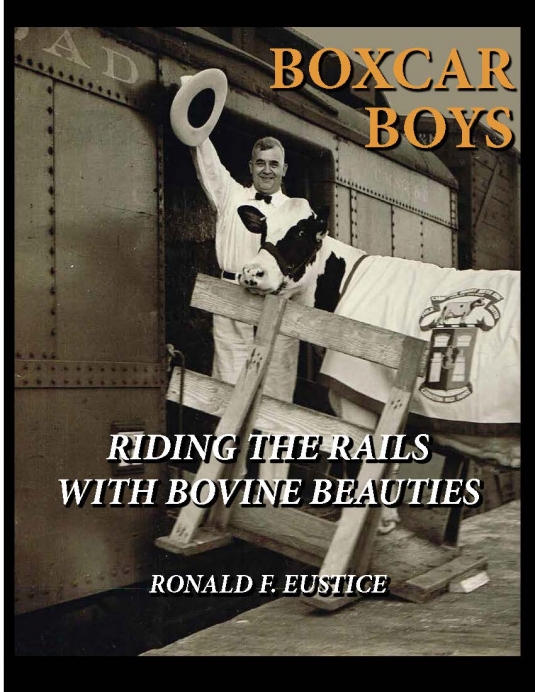
The cover of Ron Eustice’s book, “Boxcar Boys.” Below, pictured from 1945, from left: Grandma Gertrude Donelan Eustice, Thomas Donelan, Donald Eustice and Ronald Eustice.
Tough times in the ‘40s
Six decades in dairy for Ron Eustice
Six decades in dairy for Ron Eustice
Sat, 03/23/2024 - 12:32pm
Former Waseca resident Ron Eustice’s career spans more than six decades in the dairy industry. Now 78, he has made a deep impact on the cattle industry worldwide.
His ancestors John Eustice and Annie Jewison settled at Okamon near Lake Elysian in 1869. Now a resident of Tucson, Arizona, he mentions he still has deep family roots in the Waseca and Janesville area; his paternal grandmother was a Donelan.
Ron says that, for him, farming is deeply personal, especially because of where he came from.
It all started when his great-grandfather James Eustice presented a $50 war bond to one-year-old “Ronnie,” who had been born September 24, 1945 at Waseca Hospital. His parents, Donald and Alice, who had married on November 16, 1944, made the decision that beginning a dairy herd would be more beneficial than accruing interest, so they cashed in the war bond to buy a Brown Swiss cow with him as owner.
So, at just a year old, Ron began his career in the cattle industry.
“Times were tough in the ’40s,” Ron recalled. For instance, his dad, Donald, served as a soldier in World War II but was discharged after Ron’s grandfather, John, was injured in a farm accident. After that, Donald helped John with the operation, gradually drawing Ron and his three younger siblings in as they grew older.
Ron’s parents raised the family of four, including Ron, Robert, Donald and Marjorie, in Steele County’s Deerfield Township. The farmland where they worked extended into Waseca’s Blooming Grove township. Ron stated that from an early age, he loved animals, especially sheep and cattle. While Ron didn’t get to know his great-grandfather James, he remembers how close he and his Grandpa John were. Grandpa John, who lived twenty miles away, often invited Ron to do chores or run errands with him.
“Growing up on a farm was a unique experience,” Ron shared. “I didn’t realize it then. I often felt that I missed out on the experience city kids had, but through the years I have begun to appreciate the useful things I learned on the farm which prepared me for later life.”
One of the things Ron found most important was that, by performing the twice-a-day chores of feeding animals and cleaning stalls, he learned the importance of being reliable and responsible. Another source of discipline was that dairy cows needed to be milked twice every day–with no exception for holidays. His parents assigned their children chores; among Ron’s was feeding calves before he left for school.
“In the afternoons, after school, I climbed up the silo chute and threw down enough silage to feed 40 milk cows plus an additional 60 head of young stock,” Ron recalled. “[It was] Hard work, especially in the winter when much of the silage was frozen and had to be chopped loose with a pickaxe.”
He mentioned he also delivered lambs early mornings before school started during the spring. Dairy calves are born year-round; he was usually there to assist, even at a very early age.
Among Ron’s favorite memories, he says, was delivering cream in Waseca on Wednesdays and then again in Janesville on Saturdays. During those stops at the creameries, Ron and Grandpa John would also have ice cream before heading home.
“’What flavor do you want?’” Ron remembered being asked. He would always answer, “’Any kind!’” He was teased that the flavor “any” was not available before eventually settling on his real favorite, maple nut.
When he was eight years old, Ron received a lamb from his Grandpa John. Named “Spottie Face,” the sheep became the foundation for a flock of Suffolk sheep.
Ron mentioned how he especially values his memories of being with Grandpa John because their time together was short: John died in a farming accident on his sixty-fourth birthday in 1956. Ron was 12.
In 1957, Ron joined a 4-H club and showed dairy cattle, sheep, and swine at the Steele County Free Fair. He also participated in dairy and general livestock judging at the county and state levels.
“I always received blue ribbons on sheep and swine, but was disappointed in 1957 when my Guernsey yearling received a red ribbon,” Ron said. “The next year, I showed an Ayrshire calf and got a white ribbon. A year later, that same calf was Junior Champion at the District Ayrshire Show at Central Park in St. Peter.”
The Eustices’ dairy herd was mostly Holstein but by 1959, they had an occasional Guernsey and a few purebred Ayrshires.
“I became fascinated with cattle pedigrees and was excited to learn about new bulls available to mate with our cows when the inseminator arrived,” Ron remembered. “That was the beginning of a lifelong interest in genetics and a career in cattle breeding.”
The Eustices had three artificial insemination companies to choose from: Minnesota Valley Breeders’ Association, Curtiss, and Consolidated Breeders. Almost every farm for miles around had dairy cattle. At least three trucks passed by every other day to pick up the thousands of gallons of fresh milk produced in the neighborhood.
While still in high school, Ron worked three summers at Mor-Ayr Farm in Red Wing. Dr. R.B. Graves owned Mor-Ayr Farm and Jerry Strandlund managed it by 1963. The company’s herd was shown at county fairs, the Minnesota State Fair, the National Dairy Cattle Congress and the International Livestock Exposition in Chicago. “In 1963, we had the Grand Champion Ayrshire at the Minnesota State Fair,” Ron said. In 1964, Ron spent the summer at Meredith Farm in Topsfield, Massachusetts, and later showed the Grand Champion Ayrshire at the Cattle Congress in Waterloo, Iowa. In 1965, he interned at E-L-V Apache Ranch, in Lapeer, Michigan.
In 1966, Ron showed Ayrshires for Foothill Farm in St. Paul Park, which B. Dean Fisk owned. Ron also showed both male and female grand champions and helped the farm win the Premier Breeder and Premier Exhibitor awards.
Based on his love of writing, when he attended college at the University of Minnesota, Ron decided he would major in journalism; he also completed a minor in Animal Science in the College of Agriculture.
“This proved to be an ideal combination of academic training,” he added.
As he gained experience, artificial insemination (A.I.) remained one of Ron’s special interests–so much so that while he was in Mexico from 1970-72, he managed a bovine semen importation program and taught farmers and ranchers about the process. He traveled extensively in rural Mexico and worked closely with farmers to improve milk production and beef yield.
“All (A.I.) classes were taught in Spanish,” Ron elaborated, which was no issue for him since he had studied the language since high school. Throughout the years, he learned four others: German on his own at ten years old, Indonesian, French, and Italian.
A major step in his career took place in 1970, when he became Director of Field Services with Carnation de Mexico. With Carnation and later with American Breeders Service, he traveled the world and promoted US cattle genetics.
“I have met many world leaders and served as a translator for Ronald Reagan when he was governor of California,” Ron added.
In 1990, he began a 22-year career with the Minnesota Beef Promotion and Research Council, where he worked until retiring in 2012. His duties included directing all research and promotion activities statewide, teaching beef quality assurance (BQA) programs and public relations and media relations.
“I work hard and remain highly focused,” Ron said about his accumulation of writing, traveling, continual pursuit of agricultural careers, and maintaining languages. “I also try to spend time on worthwhile endeavors and don’t give up easily.”
His biggest joy and accomplishment rings pretty clear, that he has been married “nearly a half-century” –48 years–to Margaret McAndrews.
“We have an excellent marriage and Margaret has supported me through many challenges,” Ron said. “My advice is to work hard and marry the right person.” Together they raised three children: Kevin, John (1979-2012) and AnnMarie. Kevin has a PhD in Computer Science from UCLA and works at Google. AnnMarie has a degree in Interior Design at the University of Minnesota and works at Amazon. Both live in Seattle.