
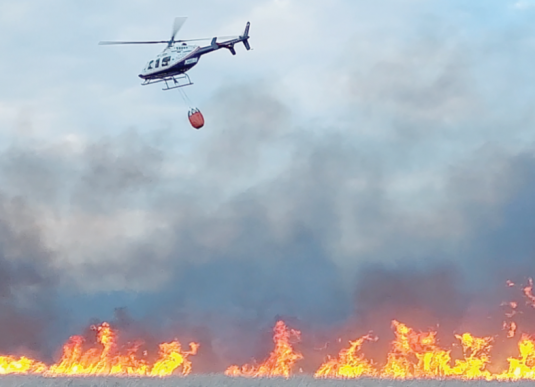
A helicopter helped with efforts to control the wildfire which burned more than 1,600 acres in Waseca County on March 3. Chris Howard, Land and Water Resources Manager for Waseca County, captured a video which included this scene. Below, areas of Moonan Marsh and Findley Wildlife Management Area are greening quickly; many plants and animals are experiencing advantages because the "litter" of previous years' growth was removed by the fire.
Wildlife, plants experiencing benefits after March 3 fire
Thu, 06/20/2024 - 5:47pm
All eyes were on Waseca County March 3 this year when a wildfire rode the day’s gusty winds across more than 1,600 acres of winter-dry grassland. Eight fire departments responded to help control the blaze, including aircraft with special firefighting materials and equipment.
It was a difficult, demanding day which threatened and delivered tragedy. Jeanine Vorland, the area wildlife manager for the Minnesota Department of Natural Resources (DNR) says she considers the efforts of everyone who helped control the fire to have been “absolutely heroic.” Thanks to their hard work and coordination, the fire didn’t damage any buildings or homes.
She remembers returning toward Waseca after fetching some equipment in the Owatonna area.
“I could see the smoke and flames from Interstate 35,” she remembers. At 40 feet tall, “the flames seemed to be licking the bottom of the clouds.”
In her position as wildlife manager, Vorland helps oversee two DNR “wildlife management areas” (WMA) which were caught up in the wildfire: Moonan Marsh and Findley.
The smaller of the two, Findley, is 287 acres of marsh, grassland and forest located on the north and west side of Waseca’s “Snake Trail” highway. Moonan Marsh, at 955 acres, is across the road on the highway’s south and east side. Thanks to the unusually strong winds which gusted up to 40 mph that day, the fire burned through Findley, then “jumped” the Snake Trail to turn many acres of Moonan’s dry grass and cattail stalks to ash.
But even during that tense, difficult battle against the fire, Vorland knew something that is becoming more and more obvious as the spring progresses. What looked like Armageddon that day was far from the end of the world.
“Fire is essential to maintain diverse habitat,” Vorland observes.
The land that is now Waseca County was home to indigenous cultures, including the Dakota Sioux for thousands of years.
Vorland says the Dakota commonly used fire to manage the land they relied on for farming, hunting and gathering. Perhaps surprisingly, much of their farming was done inside the boundaries of forests. Vorland says, fire was used regularly for a host of reasons. For one, it cleared the “understory,” disposing of the prior year’s leaves, sticks and other debris and encouraging beneficial production of nuts and berries by keeping dense vegetation from proliferating. Though they would not have used the same words to describe it, the Dakota were also aware that fire released nutrients into the soil.
The prairie would also often burn. Even a brief online search reveals numerous historic accounts describing fires of 250,000 acres and more; along with planned fires, lightning, escaped campfires, and sparks from steam locomotives are named as causes.
In addition to helping indigenous peoples farm, Vorland says the Dakota might burn part of the prairie because the new, tender growth which came up afterward would appeal to grazing animals, which they could then hunt.
“So this area has had a climate of fire management for centuries,” Vorland says. “Those fires have shaped the ecosystems and helped determine what kinds of wildlife can thrive here.”
The fire in Moonan and Findley WMAs has reset a number of factors which Vorland names off easily.
Where it reached, the fire turned the “litter” of previous years’ growth into nutrients. The shade once cast by the dense brush, dried grass and cattails has been eliminated, allowing more sunlight to strike the black soil, heating it more quickly and efficiently and encouraging the growth of “cool season” plants–those which often go dormant in the full heat of summer. The warmer ground also encourages microbes to “wake up” and begin their work enriching the soil.
The water is also less shaded, and so warms more quickly than it would have. This gives a boost to amphibians and others who lay their eggs in water, for example, allowing more frog eggs to become tadpoles. It also gives water birds open pools of shallow water where they can more easily land and feed.
Certain ground-nesting birds who prefer open lines of sight are given an advantage for the time being; among these, Vorland names the grasshopper sparrow, bobolink, sedge wren, and meadowlark.
A drive through the Moonan Marsh area confirms Vorland’s descriptions: the areas that seemed charred and ruined in March are now a rich, verdant green, looking much more appealing than the unburned areas which are still only brown.
Vorland also names grazing animals as a group which benefits from the regeneration: “Those fresh, green shoots of grass are tender and digestible,” she suggests. “They must taste mighty good after those animals have spent the whole winter hungry.” Among “grazing animals” Vorland includes not only large species like deer, but also rabbits, mice and voles. The small grazers cut and eat the grass, recycling its nutrients. They also occupy a vital location in the food web. Vorland’s phrasing is that they “live fast, die young, and feed a lot of critters along the way.”
Not only is the ecosystem of the burned area changed for now, but research shows benefits to wildlife such as pheasants will continue to increase. Vorland says the numbers of nests and the percentage of offspring raised to maturity will rise for the next four years.
She points out that, of course, her agency does not want anything like the fast-moving flames and hundreds of degrees of heat produced by March’s wildfire. But controlled burns are actually listed as a management technique for many wildlife management areas all around the state–including Moonan and Findley. “Fire is decay,” observes Vorland. “It just works a lot faster than having bacteria do the job.”
She mentions that she and others trained in “fire ecology” use burns persistently as part of their work. From her office in Rice Lake State Park, she indicates the nearby forest floor, where a burn was carried out last fall. The resulting openness has been followed by a proliferation of wildflowers.
Vorland notes that the number of planned burns this spring has been inhibited by the drought: a decreased amount of moisture increases the chances a fire might escape and cause harm in a setting like the “wildland and human interface” near Moonan Marsh. Vorland observes that days this spring have either been windy or rainy–both of which are deterrents.
But for anyone who looks at a forest or a grassland charred by fire and laments that it
has been destroyed, Vorland comments, “It’s not destroyed. It’s still there.
“It’s just different. And not all the changes are bad ones.”