
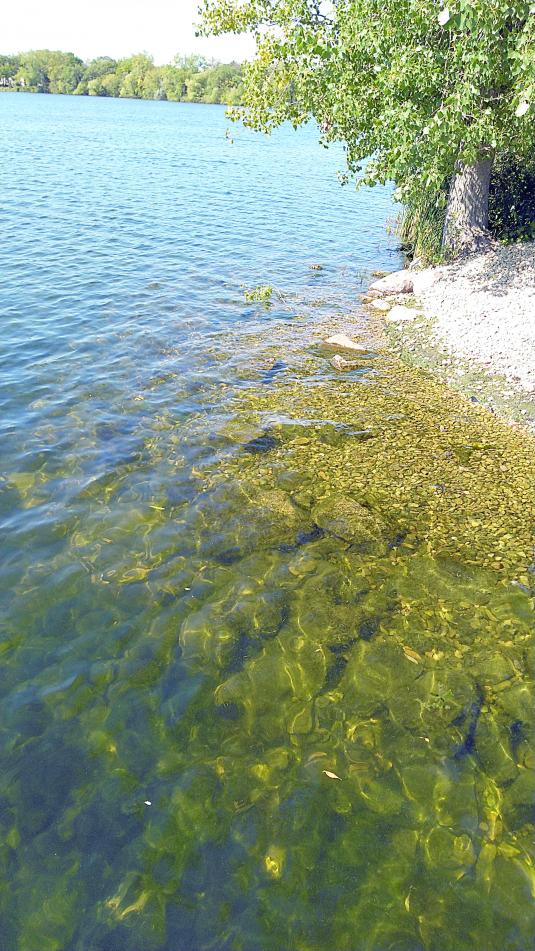
BEFORE AND AFTER - The surface of Loon Lake in September. Thanks to a specialized aeration system, the waters were able to naturally rid themselves of the rampant filamentous algae which has grown there for decades.
Waterborne miracle on Loon Lake
Madel's history with Loon Lake
Madel's history with Loon Lake
Sat, 12/31/2022 - 3:52pm
Peter Madel Jr. and his wife Mary Ann have a long history with Loon Lake.
Peter’s began about 1937, when his family moved to Waseca from Evanston, a suburb of Chicago. His family had just acquired a three-story hotel that once stood across the street from the county courthouse. Like any 7-year-old after a long journey, he took the short walk down to Trowbridge Park: “That was the leading park for kids back then,” he recalls. He also remembers making something of a stir in his Chicago-style dress shirt and slacks, given that everyone around him was wearing bib overalls and a t-shirt. “They looked at me kind of sideways,” Peter remembers. “It took me years to come out from under the impression they got of me that day.”
Even back then, Loon Lake was a definite “poor cousin” to Clear Lake. Not only was it on the wrong side of the tracks, it was weedy and unappealing. In all the time he’s been associated with Waseca, Peter believes he had never seen the bottom–except when the lake was drained, which he recalls happening twice.
His link to Loon Lake became “close” early in the 1960s when his father, who had owned a number of hotels in a number of different states, called his by-now-married son back to town to manage a different sort of hospitality–a nursing home.
Peter and Mary Ann remember being taken aback at the time. “Up until then,” Peter says, “the closest thing to a ‘nursing home’ was a widow who took care of old people in her house.” By then, Peter had served in Korea as an aide for General Taylor for two years in the US Army and a few years working for his dad managing a hotel in Vermillion, SD–where he had met and married Mary Ann two years before.
Despite their surprise at her father-in-law’s request, Mary Ann remembers, she and Peter eventually decided the job wasn’t that different from managing a hotel–especially back then. “At first, the nursing home was more for short-term stays,” she says. The facility had capacity for up to 60, but that was with double occupancy in each room.
For the next five decades, Peter continued to manage and grow Lakeshore Inn, while he and Mary Ann also raised their growing family: sons Peter III, Barry and Chris and daughter Elizabeth (now Corchran). Inescapably, given the location, Loon Lake featured in their collected memories, although not as frequently as it would have if it had not been so unappealing.
One of Peter’s favorite stories centers around a fishing pier built out into the lake in the early 1970s. Constructed personally by one of the Lakeshore Inn’s handymen, it was a sturdy, railed, T-shaped structure that extended about 18 feet out into the water. Some of the more ambulatory guests at the Inn would go out there for fresh air and sunshine, and would occasionally fish.
Unfortunately, a flock of geese also enjoyed the dock, and in a case of unlucky timing had coated it in droppings just prior to a state inspection. “They came back with a deficiency,” remembers Peter, an edge still changing the tone of his voice. “I couldn’t believe it–as if I had any control over the geese.” Still, a state “deficiency” had to be answered promptly, both with what would be done to solve the immediate problem and how it would be prevented in the future.
The obvious first step was taken: The dock was cleaned.
As for the future: “I had a sign made,” laughs Peter.
Beginning with the words “Attention all geese,” the sign declared sternly that it was against Minnesota State statute to defecate on the dock. To Peter’s complete surprise, the solution was accepted by the state agency. The story has become legend. Peter even had the chance, once, to share it with the national head of the overseeing agency–who had a good laugh.
Perhaps most remarkably, the sign seems to have worked. “The geese never went on the dock after that,” Peter recalls. The sign, and the dock, stayed in place for roughly 20 years–but Mary Ann remembers that the mosquitoes eventually became so intimidating that hardly anyone would go out there anymore, and so the dock was taken down.
Mary Ann also relates that each of the couple’s four children had jobs at the Lakeshore Inn during their high school years. She vividly recalls times after their shifts had ended when her three boys would hop into a canoe and paddle out to the island in the middle of Loon Lake.
“The weeds would just drag on their paddles,” she remembers. “They would lift them up, and they would be covered in green. They would have to be cleaned off before the boys could paddle with them again.”
Though that was decades ago and the boys in question now look more like grandparents than venturesome vagabonds–they knew of a secret field of hemp growing on the island–the story of the lake was always more of the same.
“Weeds, all summer long,” declares Mary Ann.
“I’d been seeing the lake since before I was ten years old,” says Peter, now 92. “It was never anything but weedy.” As for any fishing, he remembers mostly bullheads.
“It was a green lake, pure and simple,” he says.
Between them, he and Mary Ann list adjectives like “filthy,” “grungy,” and “ugly.” Peter draws an analogy to split pea soup, and says that even seeing the water would require shoving a hole in a huge, thick coating of filamentous algae.
But to the couple’s complete amazement, a lifetime of experience was changed this August. Thanks to a specialized type of water treatment–one still under development and thus being used on a test basis–Peter and Mary Ann speak in tones of wonder.
“I could see fish swimming,” chirps Mary Ann.
“I’ve known that lake for 60 years and I’d never seen the bottom,” says Peter, “but I could see it.” He then adds jokingly: “It’s a wonder there weren’t any bodies!”
“Whatever process they’re using,” he says, “it sure is doing a great job.”
“Wouldn’t it be nice,” asks Mary Ann rhetorically, “if that’s how it looks from now on?”