
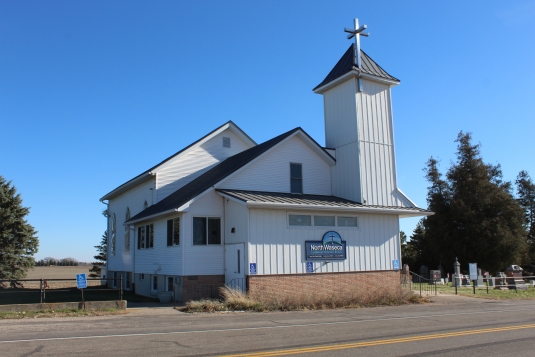
NORTH WASECA LUTHERAN - Known as “the church on the hill” North Waseca is more than 165 years old.
Local church celebrates Scandinavian roots
Tue, 01/02/2024 - 3:13pm
The tables in the basement of North Waseca Lutheran Church are mounded with Scandinavian treats. The largest space is occupied by pre-counted, labeled bags of lefse; church members Roy Srp and Greg Thomson have been receiving orders for the last two weeks. Today customers are pulling up outside, being greeted by Srp or Thomson, and having their orders delivered to their cars.
The system, like the lefse sale, was devised during the pandemic. It was the best substitute organizers could find for their annual Scandinavian (i.e. lutefisk and Swedish meatballs) dinner which had to be put on hold for four years.
To their pleasure and relief, the Scandinavian dinner returned this year, feeding 220 people in three one-hour shifts on Sunday, Nov. 12. Long-time organizer Greg Thomson passed the reins on to Ryan Miller, who had been helping with the meal since 2012. Miller says there is a fair amount of work in being sure everything is ready for the event–the first planning session took place about two months in advance. But because so many volunteers and participants were anxious to see the tradition return, things fell into place rather smoothly. The only real challenge, he says, arose when the number of interested diners was so high that the originally planned two shifts were expanded to be three.
“We were all excited to see this tradition return,” Miller comments. “It was an honor to take over.”
About 50 volunteers put in many hours planning, preparing for and then serving the much-anticipated meal, which had been a tradition at the church for 35 years. In the center of the action were lutefisk cooks Duane Johnson, 86; Jim Hansen, 75; and their recent protege Nathan Schultz, 36.
Schultz admits he had never before even tasted lutefisk, but was willing to fill in wherever he was needed. The experienced cooks, he says, “have it down to a science,” and so he contented himself with doing what was asked of him and observing the masters at work.
Cheryl and Dan Forrest and Sonja Thomson explain that lutefisk would probably be a universal favorite if everyone who prepared it could do so correctly. Cheryl describes it as flaky, buttery baked cod that can be indescribably good, while Dan warns that, if overcooked, the effect is ruined. Thus, all volunteers present express their admiration for the three cooks, two of whom have been giving their time and talents for decades, and one of whom has shown a genuine aptitude for the task despite being something of a newcomer.
In the meantime, the lefse sale had become its own successful tradition, and so here are the volunteers, busily locating and delivering the labeled bags.
Although there are at least two capable lefse cooks present, the product here was purchased from a bakery in Rushford. The 550 rounds which were ordered, they explain, would have been too much to ask of a home based kitchen.
Both the Scandinavian dinner and the lefse sale are charitable fundraisers operated by the church in support of food shelves in Waseca, Waterville and Elysian, the communities from which the majority of church members come. Roughly $2,000 were raised by the dinner; today’s activities will bring in about another $500.
As the lutefisk dinner and the lefse sale illustrate, North Waseca Lutheran is looooong on tradition. The church began in the 1840s, before Minnesota was even recognized as a state. After meeting in private homes for 15 or so years, the congregation built its church on land donated by one of its members.
According to church members, services were held in Norwegian into the 1920s: Back in that time, men sat on one side of the church while women and children took the other side.
The church remained the center of its rural community for many decades. Lifetime member Dolores Srp remembers a time when the only bathroom was an outhouse and the only on-site source of water was a small hand pump located in the kitchen. “We would bring water from home when there was a larger event,” recalls Cheryl Forrest.
All that was modernized in the 1960s when an addition brought in modern plumbing and increased the church’s size by nearly half, while also leading to the replacement of the high, steep concrete stairs which were once the entryway.
A centerpiece of the church is the tall, traditional altar with a painting of Christ on the cross. The painting was commissioned from a Norwegian artist back near the congregation’s beginning.
Longstanding members know the history and past uses of nearly every nook and cranny of the building.
Dolores Srp remembers back to her youth when the school bus simply delivered youth choir members to the church on Wednesday afternoons, since that’s when weekly practices were held. Cheryl Forrest recalls the school bus would drop her off there when neighborhood women–including her mother–were attending “ladies’ aid” meetings. “Well,” she remembers, “Dad would be in the field and Mom would be here–so it was where I needed to be, too.”
Church volunteers want everyone to know the congregation holds its services at 8:45 a.m. each Sunday. Scandinavian ancestry is not an expectation, they reassure.
Lutefisk apprentice Nathan Schultz agrees. He and his family moved to the Waseca area in 2019. When choosing a church, he said, they attended a few in town. When they attended North Waseca, he said, “Everybody was so friendly–they made us feel as if we had always been members there.”
“People come here now because we’re welcoming and we have a real sense of community,” suggests Greg Thomson. “We’re glad to have new people, and we’re glad for their energy and their fresh perspective.”