
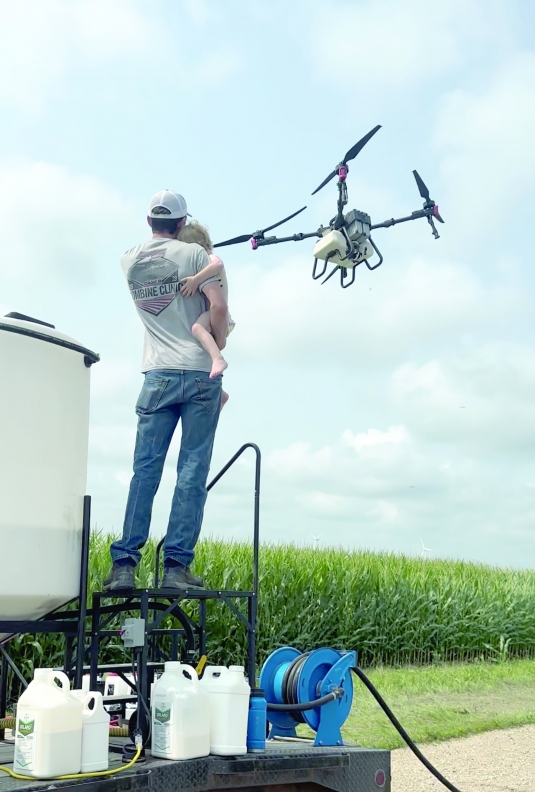
TenacityAg dealer Daniel Nelson and his son Benjamin, then 2, watch as a drone approaches. In addition to selling agricultural drones across a wide region that includes Waseca County, Nelson owns a custom spraying business near Windom.
Drones diversity fieldwork options, create possibilities
Wed, 05/14/2025 - 7:30pm
Tenacity Ag dealer Daniel Nelson has a number of drones for agricultural use in the Waseca area. With his family, Nelson farms 3,000 acres of corn and soybeans near Windom, operates three turkey finishing barns, and has a custom spraying business. When it comes to drones, he admits to being something of a convert.
“Five or six years ago I saw a drone at Farmfest and I laughed,” he remembers. “I didn’t think they could ever be practical for the scale needed in agriculture.”
Advancement has been rapid since then, Nelson observes. The largest agricultural drone Tenacity offers at this time is the XAG P150. When set up to be a sprayer, it can carry 18.5 gallons of fluid and deliver it across fields from a height of 12 feet. With batteries which recharge quickly enough to provide continuous operation, Nelson offers the example that a drone can treat a 120-acre field in about two hours.
The P150 drone has a base price of $42,000; Nelson estimates the typical price of a high-boy at about $500,000.
Nelson tells of having used two drone sprayers in his custom business last summer. “I had a lot of farmers who booked me to do 40-acre plots,” he recalls. “They wanted to see what this new technology could do.”
This year, enough of his customers have already arranged to have him spray their whole farms that, he says, he’s started “turning away the customers who only want 40 acres.”
When it comes to distributing fluids across a planted crop, Nelson explains, farmers have typically had three choices: They can use traditional “pull behind” sprayers hooked to a tractor, they can own or hire a “high-boy,” or they can hire an airplane to spray.
Each system has specific strengths and weaknesses.
Most farmers own a “pull-behind” sprayer and can use it whenever they wish. However, the unfortunate collateral damage of crushing a certain percentage of the plants while driving equipment through a field leads to a reduction in yield. Also, the system becomes unusable in cornfields once the plants reach a certain height.
High-boys are expensive either to own or hire. Like the pull-behinds, their tires also damage growing plants, both as they drive down rows and as they turn around at the ends of the field.
Airplane sprayers, Nelson describes, have two down sides. First, they must lift away from the field if there are trees or power lines at the edges. Second, “spraying companies give the farmer a window of two weeks or more, and they come anytime in that window.” In other words, spraying often becomes inefficient at field edges, and the farmer has little control over when the chemicals are applied. This can be particularly detrimental in the case of fungicides, Nelson mentions, because those are best delivered shortly after a rainfall or early or late in the day when condensed moisture is on the plants.
Nelson speaks of studies done by Pioneer and Beck’s seed companies which show drones can outperform airplane or ground systems when it comes to the distribution of chemicals. “It’s not always monumental,” he says of the differences found in various studies. “But for the cost and the performance, I believe it’s well worth it.”
He mentions downdraft from a drone’s propellers has been shown to push liquids further into the crops’ canopy, leading to better coverage. Farmers who own their drones or who work closely with a custom sprayer can arrange the time liquids are applied. And, of course, drones have what Nelson calls “zero crop interference.”
Nelson also brings up the “comfort factor,” stating lightheartedly that drones are so autonomous the operator can sit in a lawn chair in the shade and watch as the equipment performs.
“They have obstacle avoidance built in,” he says. “Once you turn them on and get them going, they automatically return to the station to refill themselves.”
Nelson says those who own drones can transport them using “pickup box rigs” or can choose “elaborate tender units” with tanks for water and product and a generator to recharge batteries on site–a process which can take as little as nine minutes.
When outfitted as a “spreader,” Nelson goes on to describe, the P150 drone can take up to 155 pounds of seed in a specially designed hopper. He mentions the possibility of delivering cereal rye, radish or turnip seeds among corn late in the season so the cover crop can begin growing prior to harvest.
Another use for the spreader option, he points out, is to replant drowned out spots in fields–either with soybeans, or with a cover crop to impede weed growth.
Nelson is in the process of expanding his role as a drone dealership, with a new shop under construction near Mountain Lake. Soon, he plans to have a staff member dedicated to customer service and repair and expects to expand his custom spraying as well.
“There are plenty of people waiting to see where this technology goes,” he says of using drones in agriculture. “As for me, I’ve sprayed 4,000 acres. I’ve seen what the future is bringing and I’m glad to be part of it.”
Nelson’s branch of Tenacity Ag can be reached by calling 507-831-4072.