
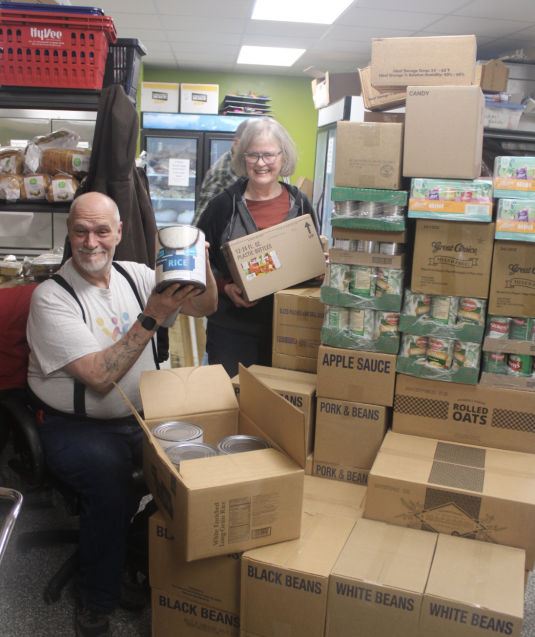
VOLUNTEER GOOD - Waseca Area Food Shelf volunteers Garry Huckfeldt and Jonna Moens stock supplies from a recent delivery onto shelves for distribution to clients.
Donations 'now' give extra value
Thu, 03/19/2026 - 12:45am
Ask her anytime and Cindy Kolander, executive director of the Waseca Area Neighborhood Service Center and its associated food shelf, will almost certainly say “Now!” is the best time to donate to the organization.
“Now” is especially true through April 6, because donations during the window of March 1 to April 6 are being taken into account toward the 45th Annual Minnesota FoodShare March campaign results. After the campaign closes, more than 300 food shelf organizations will submit two numbers: the count of clients served and the value of donations (pounds of food and dollars) received within the time frame.
Minnesota FoodShare will then distribute funds it has raised in amounts relative to the reported numbers. The more donations an agency has garnered, and the more clients it has served, the larger the contribution the Waseca Area Food Shelf will receive from the March FoodShare campaign.
“Every dollar and pound of food counts,” proclaims Kolander, “so we’re doing what we can to get the highest numbers we can achieve.”
Kolander expresses gratitude for an arrangement through the Waseca Area Chamber of Commerce to help promote this event. Organizations such as the local Rotary, Exchange and Lions clubs; along with churches, schools and businesses have been collecting money and food since the beginning of the month.
She also praises the local scouting organization, which has run an annual “Scouting for Food” campaign for decades. During March, many Waseca residents will find a note on their doors announcing when the Scouts will return; the hope is that people will set food out on their doorsteps to be collected on the morning of Saturday March 21st and brought directly to the food shelf. Kolander mentions last year’s Scouting event brought in 2,500 pounds of food.
Still, Kolander says, “The need is great.” In 2025 the food shelf assisted 1,098 client households (2,539 individuals) which was an increase of over 20% from the record number of clients it served in 2024. The majority of the households required food support an average of 6 times during the year. This led to the Waseca Area Food Shelf assisting these households 6,708 times ( 14,791 individuals) with 212,791 pounds of food taken home to their families.
Kolander shares that, when she was hired to be the executive director for the Neighborhood Service Center in 2023, she did not understand how vital the organization's support is.
Since then, she says, she has received statements of thanks from people who had tears in their eyes.
“They tell me, ‘You helped me get my confidence back.’ They talk about how desperate they were feeling when they didn’t know where their next meal was coming from. They come back and make donations because they want to help other people.
“They let me and our staff know, in so many different ways, how valuable the food shelf and the thrift store have been for them.”
She goes on to explain that sales of donations made to the organization’s thrift store support many of the WANSC programs, including things as basic as paying the light bill.
“We had a rough summer,” she comments regarding sales, remembering that large-scale construction along Second Street Northwest closed not only the roadway, but even the sidewalks, making it difficult to continue operating the food shelf and impossible to maintain sales hours at the thrift shop.
The Waseca Area Food Shelf is open each weekday from 9 a.m. to noon, and then again from 1 to 4 p.m. The one-hour closure at mid-day is so that shelves can be restocked and workers have time to eat lunch. Visits are by appointment; people are asked to call 507-833-4119, ext. 302 to schedule a time.
“We’re here to provide people with a balanced selection of food,” Kolander describes. “We want to send home a variety of choices from across the nutrition guidelines.”
This means, she says, clients are encouraged to take canned or frozen vegetables and fruits, proteins, grains, and dairy products. Fresh fruits and vegetables are also sometimes available through “retail rescue” arrangements with local stores. In summer, the food shelf also makes contact with area gardeners and the University of Minnesota Southern Outreach Center (SROC), where vegetables are grown as part of the facility’s research. Kolander recalled incidents from the past few summers when SROC offered the food shelf whole plots of vegetables, literally “ripe for the picking.”
Kolander says proteins–including beef or pork, poultry, fish, legumes, nut products such as peanut butter –”are seldom donated,” and so the food shelf purchases them, when possible, from their Regional food bank named Channel One, operating out of Rochester and serving many food shelves across southern Minnesota. When Channel One has none to sell, she continues, the food shelf will make arrangements to buy meat and proteins from local retailers, who often agree to somewhat reduced prices.
As people consider making donations to the food shelf, Kolander says the facility welcomes all properly packaged and preserved foods. Thanks to the lower-than-retail prices offered by Channel One or other wholesale food outlets, she suggests money is an excellent choice because the food shelf can use it to order the foods it needs at any given time, and can buy them at wholesale prices, which is approximately 1/3 of regular retail costs.