
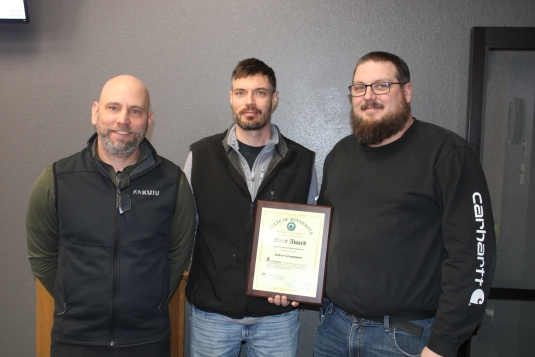
The Waseca County Highway engineering team recently received an award for the "rehabilitation" project on County State Aid Highway 3 completed last summer between Janesville and Waldorf. Pictured here (from left) are Waseca County Highway Engineer Jim Kollar, engineering supervisor Josh Smith, and engineer technician Andrew Graupmann, who worked on the project.
County highway project named best in state
Thu, 04/02/2026 - 2:00am
A project performed last summer “rehabilitating” a five-mile stretch of Waseca County State Aid Highway (CSAH) 3 was recently acknowledged as the best of its type in the state of Minnesota. The county engineering team, which consists of engineer Jim Kollar, supervisor Josh Smith and technician Andrew Graupmann were guests at a March 11 banquet at Breezy Point Resort in Brainerd to receive the award; sharing the accolades were representatives of the St. Michael-based contractor PCiRoads, the company which performed the work.
Awards were presented by the Concrete Paving Association of Minnesota (CPAM). According to CPAM spokesperson Dan Labo, as many as 10 projects statewide were eligible; winners were selected by a committee of industry professionals from both the Minnesota Department of Transportation (MNDoT) and CPAM.
Criteria in the “concrete pavement rehabilitation” category, Labo says, include “the performance of the concrete repairs at least 30 days post construction,” as well as “the total project scope,” including the quantity and types of repairs performed, the quality of the material, and factors such as traffic rerouting and schedule considerations.
Todd Callahan, vice president of concrete paving and concrete paving rehabilitation for PCiRoads, said the company is grateful to have been the contractor for the CSAH 3 project, and greatly pleased to have been named “best in the state for some of our work.”
Waseca Highway Engineer Jim Kollar complimented the dedication shown by Smith and Graupmann, saying they put in close to 1,400 hours surveying and assessing defects for the project before it began, then supervising and checking quality controls as the work took place from April to September of 2025.
“They walked the road repeatedly,” he said of Smith and Graupmann. “They were out with the contractor quantifying, testing and sampling to be sure the project was meeting specifications. They put in many evening and weekend hours.”
Kollar shared that the portion of CSAH 3 was first built in 1991. With the rehabilitation work complete, he anticipates its overall usable life will be 50 years or more. CSAH 3, he mentioned, bears more than 2,000 vehicles a day, many of them heavy trucks.
One unusual aspect of the project described by the county engineering team was a “dip” in the driving surface, where a length of road nearly 200 feet long had been growing steadily deeper, becoming as much as 2 feet lower than originally constructed over the life of the highway.
During the construction planning phase, a geologic boring showed a layer of peat about 80 feet below the surface. The peat, it was determined, had been steadily compacting due to the weight of the traffic, the road and the fill materials supporting it.
The solution to reducing future settlement was to replace some of the roadway embankment with lighter material–the contractor was offered the choice of either wood chips or shredded rubber tires. The rubber tires turned out to be the better choice for conditions, and so now a 216-foot stretch of the road is supported by a layer of shredded rubber about 60 feet wide and 10 feet deep, along with some other fill materials.
Kollar said he decided to complete the lengthy application process for the statewide award for a number of reasons, including to highlight the efficiency and dedication of the county engineering staff and the quality of the project.
Asked what they want the public to know about their work, Smith and Graupmann said they want people to think of road construction as a scientifically based process, sometimes with factors and elements which may not be evident until the entire project is complete.
“People will see work going on, and they don’t always understand what they’re seeing is just one phase,” said Smith. “And it doesn’t reflect how the finished project will look or perform.”