
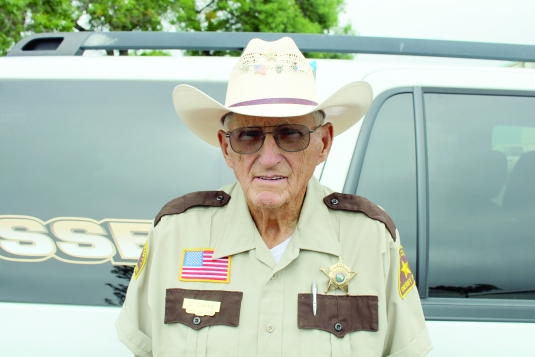
DEDICATED SERVICE - Janesville area resident Dave Lienke has been a member of the Waseca County Sheriff’s Posse since 1976. Pioneer photo by Deb Bently
Dave Lienke describes 50 years with sheriff’s posse
Thu, 09/17/2026 - 9:30am
Janesville area resident Dave Lienke joined the Waseca County Sheriff’s Posse in 1976 and has served continuously for the past 50 years. He says he was invited to join back then by Paul Stennes, who felt the posse needed additional members. Since expectations for membership included having a horse and being able to transport it to service locations, he says he accepted at least partly because he met those requirements, and knew the pool of eligible participants was limited.
“I’ve never regretted it,” he affirms.
Across his 50 years, he says he has ridden seven or eight different horses at posse events.
Waseca County Sheriff Jay Dulas observes, “it is rare to celebrate a major milestone that honors a half century of dedication to an organization,” and continues on to say Lienke’s service shows the level of dedication his generation aspired to.
Lienke says he remembers a few times in the first years of his membership when posse members were asked to carry a sidearm, but that has not been the case for decades. He says he has never felt unsafe in the role, which he describes as being “the eyes and ears of the sheriff” when called upon for assistance.
Dulas remarks, “Dave’s contributions and volunteer hours to the posse organization and the community are priceless. Dave has not only been a member for 50 years, he has been an active and contributing member who attends meetings, serves at events, and still rides his horse. We look forward to his continued contributions in the years ahead.”
Clearly the most visible role of the posse, Leinke observes, is representing the sheriff’s office in parades. He mentions that, as dignified and ceremonial as posse members may appear while riding in formation, they are also simultaneously available if any safety or security issues should arise.
Being on horseback, he points out, provides some inherent advantages. To start with, since people tend to respect and admire horses, the animal’s presence usually builds goodwill. The horse’s size lends authority and speed: People tend to step out of the way.
However, Lienke suggests the largest advantage of being on horseback is having a line of sight which begins about 4 feet above everyone else’s heads, allowing riders to both see over most of the crowd, and see farther ahead. All these factors, he says, have been consistently helpful in his time with the posse.
Posse members can also be seen fairly frequently without their horses at dances, public gatherings, and other events, where Lienke says their role is best served when they mingle among the crowd. Even though he’s been on the posse for half a century, and is deputized to carry out many tasks, the only confrontational situations he remembers handling have been a few boisterous people at events whom he has had to “talk down” from impulsive behavior.
The most sobering tasks posse members face, he says, tend to be far less public than dances and parades.
He has assisted with a number of searches, some for individuals believed to be injured or even possibly deceased. Those assignments, he says, are often somber and subdued. The horses apparently recognize the gravity of the situation; Lienke says they typically seem edgy and uncomfortable. Of those types of service, he chooses to say only “Not every search ends the way you hope it will.”
Lienke says he is happy to serve in any setting his role as a posse member calls for, and feels the work he is doing makes a valuable contribution.
The incident which brings him the largest sense of accomplishment occurred a few decades ago near Matawan. The Waseca County Sheriff’s Posse had been invited to assist with a search for a missing 4-year-old child who had only recently been placed in his foster father’s custody. Perhaps because he did not yet feel at home, the boy had wandered away. The search took place over a variety of terrain that included a pond, fenced-in fields, a wooded area, and crops, including cornfields of a height reached shortly before harvest.
Because the child was known to enjoy fishing, the search was somewhat focused around the pond, but Lienke decided he would move away from the group. “We were going along the edge of a cornfield,” he says of himself and his horse, when suddenly, “the horse stopped, looked into the field, perked his ears and looked interested,” Lienke describes.
They turned down a cornrow and a ways in they found the boy sitting on the ground and crying quietly.
“I just gave the horse his head,” Lienke says of the incident. “I didn’t find the boy, I only helped.”
Though the child was uneasy at first, Lienke was able to convince him to sit in the saddle with him. “He got used to it pretty quick. I think it wasn’t long before he enjoyed it.”
That moment, he describes, the feeling of finding the boy uninjured when it had been feared he might have drowned in the pond, is still his most fulfilling, poignant experience from being on the posse. “At least that one search,” he comments, “did end the way we had hoped.”